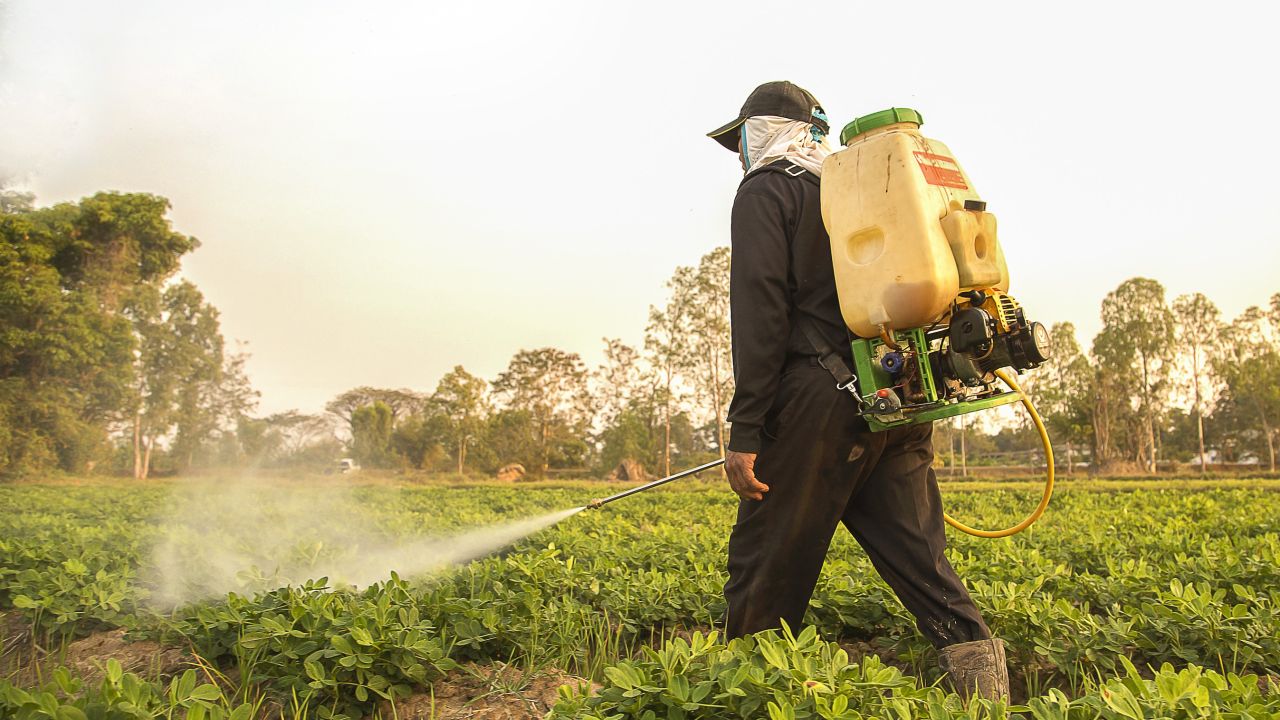
For decades, regulators knew paraquat was harmful but failed to address the risks

Paraquat is a highly toxic agricultural chemical that has been sprayed on fields for decades. Its value as a herbicide was discovered in 1955. It was introduced for commercial use in 1962 and the Environmental Protection Agency classified it as a “restricted-use pesticide” in 1978.

For years, it has been one of the most prevalent pesticides in U.S. agriculture. Its application skyrocketed in the 2010s. More than 70 countries have banned paraquat use due to its acute and chronic health risks – it’s time for the EPA and states to ban it.

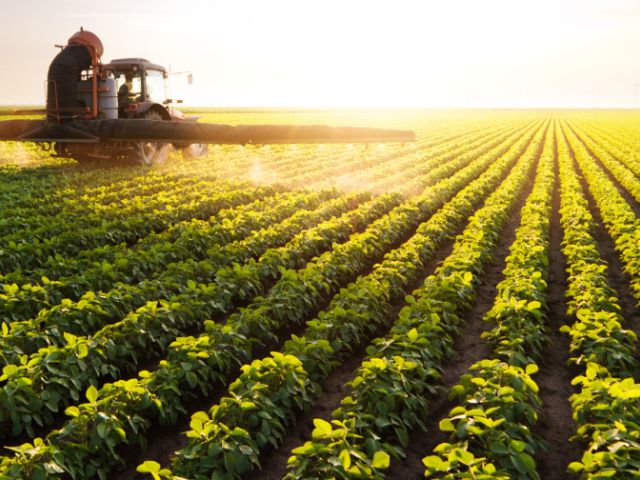
Research and studies available to the public, along with well-documented federal actions – and inactions – detail more than 60 years of government failure to protect the public from the dangers of the toxic pesticide paraquat. Exposure to the chemical is linked to greater risk of developing Parkinson’s disease and other serious health harms.

Pre-1980

1958

Study shows paraquat’s chemical class has the potential to affect the central nervous system and be absorbed through the skin.

DOWNLOAD

1964

The EPA registers paraquat for use in the U.S.

DOWNLOAD
DOWNLOAD
 

1974

California regulators’ concerns signal to federal regulators that acute on-the-ground health evidence is accumulating.

DOWNLOAD

1974

The EPA internally considers cancelling paraquat’s registration, citing “no known medical treatment to prevent fatality from exposure.” due to acute harms. But it takes no action.

DOWNLOAD

1978

Classifying paraquat for “restricted use,” the EPA accepts it for special review, citing concerns such as potential harm to the developing fetus and other chronic effects not including neurological harms.

DOWNLOAD

1979

Published peer-reviewed study shows paraquat’s capacity to cause brain damage.

DOWNLOAD

1980s

Scientific evidence of harm builds

By the mid-1980s, the EPA has access to recent peer-reviewed science connecting paraquat to Parkinson’s disease. The EPA opens – then closes – a formal review. 

1980

University medical researchers document changes to the brain in eight patients who die of paraquat poisoning in one of the first peer-reviewed reports about effects on the brain.

DOWNLOAD

1982

After finishing its special review, the EPA clears paraquat for continued use, having never examined harms to the nervous system. The agency excluded a lifetime cancer study and multi-generational reproductive study that paraquat manufacturers submitted.

DOWNLOAD

1983

Sweden becomes one of the first countries to name paraquat a Class 1 hazardous substance and restrict its use.

DOWNLOAD

1985

Scientists publish a landmark study in Science showing how paraquat structurally resembles MPTP, a compound known to cause Parkinson’s disease. The study’s hypothesis: Paraquat, like MPTP, may damage dopamine-producing neurons. This peer-reviewed finding is available to the EPA.

DOWNLOAD

1985

California’s Department of Food and Agriculture asks paraquat companies whether it causes Parkinson’s.

DOWNLOAD

1985

Kuwait bans paraquat.

DOWNLOAD

1986

Finland bans paraquat.

DOWNLOAD

1987

The EPA scrutinizes paraquat’s safety, noting it as a possible human carcinogen. In the years that follow, independent studies further link paraquat exposure to Parkinson’s, a risk that the agency’s review never examined.
DOWNLOAD

1987

A letter in the journal Neurology raises the paraquat-Parkinson’s connection explicitly, inserting the question into widely available peer-reviewed medical literature.

DOWNLOAD

1988

A peer-reviewed study in the journal Neurotoxicology documents brain damage in a fatal case of paraquat poisoning. The EPA later cites the article in its reference materials.

DOWNLOAD
DOWNLOAD

1990s

Evidence accumulates 

Multiple peer-reviewed epidemiological studies in the public domain show elevated Parkinson’s risk in populations exposed to paraquat. The EPA re-registers paraquat in 1997 without fully addressing this evidence.

1990

A publicly available study of rural residents in British Columbia, where Parkinson’s is especially prevalent, finds strong association between paraquat use and Parkinson’s.

DOWNLOAD

1992

A peer-reviewed study of 130 Canadian Parkinson’s patients connects occupational herbicide use with a threefold higher risk of the disease.

DOWNLOAD

1993

Austria bans paraquat.

DOWNLOAD

1994

A further publicly available study of Parkinson’s in British Columbia, published in Movement Disorders, narrows earlier findings to agricultural workers with occupational pesticide exposure in the tree fruit sector.

DOWNLOAD

1995

Denmark bans paraquat.

DOWNLOAD

1997

A peer-reviewed study in Neurology examines 120 Parkinson’s patients in Taiwan and finds that paraquat users face more than a threefold higher risk of Parkinson’s, compared to non-users. 

DOWNLOAD

1997

The EPA approves continued use of paraquat. Despite referring to neurotoxicity in the final published decision, the agency says it lacks enough evidence to establish a link between paraquat and Parkinson’s. 
DOWNLOAD

1997

EPA removes respirator requirements from paraquat product labels. This was reversed 4 years later following worker safety concerns that California regulators submitted to the EPA.

DOWNLOAD

1999-2010

Increasingly robust independent and federally backed science proliferates linking paraquat to Parkinson’s disease and supporting severe restrictions or bans on paraquat.

1999

A peer-reviewed study in mice shows paraquat exposure depletes dopamine-producing neurons and produces hallmarks of Parkinson’s disease, more evidence of the swiftly accumulating body of research. 

DOWNLOAD

2000

Researchers funded by the National Institutes of Health show that combined exposure to paraquat and the fungicide maneb cause damage to dopamine-producing neurons, a greater effect than either substance alone.

DOWNLOAD

2002

Further peer-reviewed studies link paraquat exposure to selective degeneration of dopamine-producing neurons in the region of the brain affected by Parkinson’s.

DOWNLOAD

2005

Peer-reviewed research shows how paraquat is toxic to dopamine-producing neurons.

DOWNLOAD

2007

A federally funded study drawing on the National Institutes for Health Agricultural Health Study, a prospective cohort of over 84,000 licensed pesticide applicators, finds paraquat use is associated with higher prevalence of Parkinson’s disease. The study is co-sponsored by the EPA and the agency has direct access to the findings.
DOWNLOAD

2007

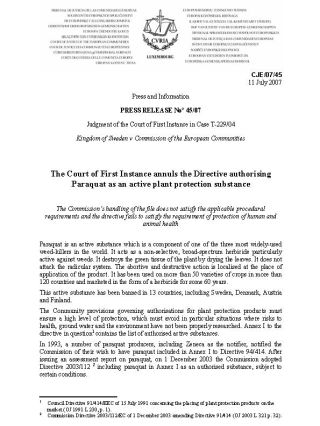
The European Union revokes paraquat registrations. Syngenta, which makes paraquat, declines to resubmit for EU registration.
DOWNLOAD

2009

A second peer-reviewed study shows chronic oral ingestion of paraquat also triggers dopamine-neuron degeneration in mice, expanding the evidence beyond injection-only models.

DOWNLOAD

2009

A peer-reviewed study finds people living within 500 meters of paraquat-applied fields face much higher Parkinson’s disease risk. 

DOWNLOAD

2011-2019

EPA’s new review stalls

In 2011, the EPA opened its current registration review cycle for paraquat. During the following decade, more peer-reviewed studies emerge. These studies include findings from the NIH’s own Agricultural Health Study.

The EPA’s review stretches nearly a decade before producing an interim decision, in 2021.

2011

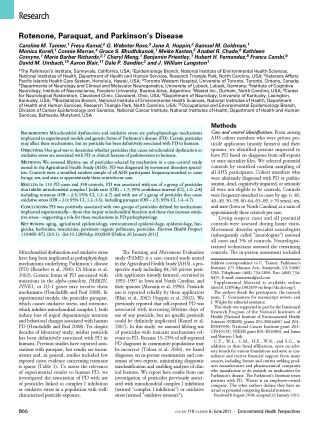
The findings based on the NIH Agricultural Health Study finds paraquat applicators are 2.5 times more likely to develop Parkinson’s than non-users. This  U.S. government-funded science is available to the EPA.
DOWNLOAD

2011

The EPA opens its current registration review cycle for paraquat. The review will take more than a decade to produce an interim decision.

DOWNLOAD

2012

A peer-reviewed study from authors at the Parkinson’s Institute finds that a genetic variant common in the general population increases the risk of the disease from paraquat exposure, suggesting a large subset of the public faces heightened risk.

DOWNLOAD

2012

China announces its intent to ban paraquat, citing the need to protect public health.

DOWNLOAD

2013

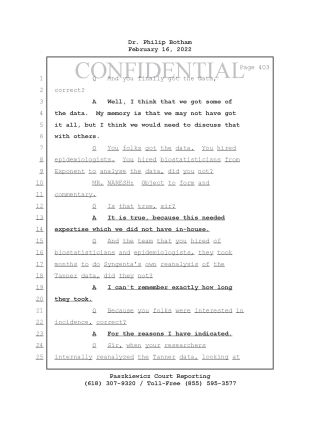
Paraquat manufacturer Syngenta conducts an internal study confirming previous NIH findings of a 250% increase in incidences of Parkinson’s disease among workers using it. 
DOWNLOAD

2017

Brazil bans paraquat.

DOWNLOAD

2018

A meta-analysis of 13 epidemiological studies finds that occupational and environmental paraquat exposure increases the risk of developing Parkinson’s disease by 64%.

DOWNLOAD

2019

EPA releases its draft human health risk assessment for paraquat, acknowledging it has historically received feedback from the public linking paraquat to Parkinson’s disease. But the agency’s review concludes that “the weight of evidence was insufficient.”

DOWNLOAD

2020-present

A decade of review yields an interim decision and then a retraction.
2020

The EPA declines to ban or cancel paraquat registration.

DOWNLOAD

2021

The EPA releases an interim registration decision on paraquat, imposing new use restrictions, but stops short of cancellation. The agency rejects expert advice from the National Toxicological Program to consider animal studies, excluding 90% of research in its disease analysis.

DOWNLOAD
DOWNLOAD
 

2021

On behalf of farmworkers, the environmental nonprofit Earthjustice sues the EPA, arguing it has failed to adequately account for neurological evidence of paraquat’s harm.

DOWNLOAD

2022

Canada discontinues registration for paraquat products.

DOWNLOAD

2024

A study of California residents finds that living or working near paraquat-applied fields more than doubles the odds of developing Parkinson’s.

DOWNLOAD

2025

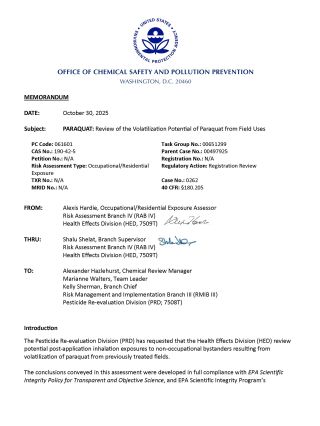
The EPA’s preliminary analysis of industry data suggests uncertainty about paraquat drift and the possibility it may travel farther than previously understood.
DOWNLOAD

2025

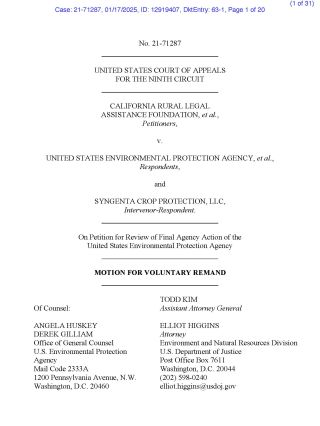
The EPA withdraws its interim registration decision for paraquat and calls for more research, effectively restarting a review already lasting a decade. Paraquat remains on the market.
DOWNLOAD

2026

Twenty former EPA officials sign a letter calling for a ban on the use of paraquat.

DOWNLOAD
We’re in this together

Donate today and join the fight to protect our environmental health.

Topics
Learn about these issues