News & Insights
Curious about developments in public health that may affect you and your environment? We have the latest information to keep you up to date and in the know.
Featured News

Avoid or limit foods containing potassium bromate.
Potassium bromate has been classified as a possible carcinogen by the World Health Organization’s cancer research agency, based on...

WASHINGTON – About 197 million people in the U.S. drink drinking water contaminated with the toxic “forever chemicals” known as PFAS, according to test data released by the Environmental Protection...

Neonicotinoid insecticides, notorious for their role in the collapse of bee populations, are turning up in human semen and may be linked to lower sperm count, a new peer-reviewed study finds.
Researche...

Food was on the table during the election – and voters are hungry for change.
While many issues mattered to voters, polling shows that food issues like rising food inflation, food safety and how food...

Avoid or limit foods containing propyl paraben.
Propyl paraben is a synthetic preservative shown in studies to mimic the hormone estrogen, raising concerns about its potential to...

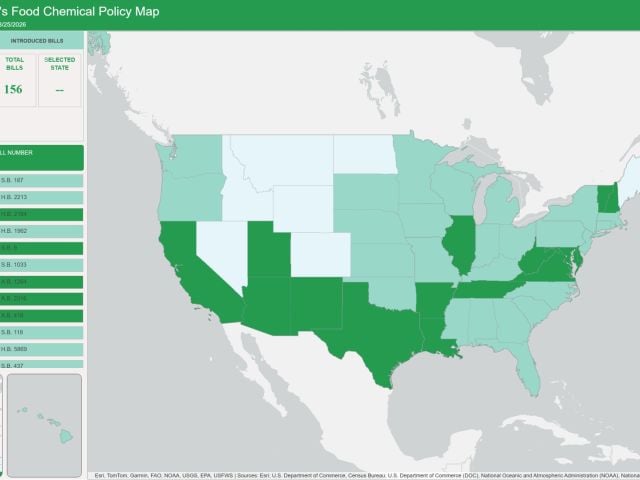
More than a dozen states have now passed laws restricting certain chemicals from food. Most apply to food served in schools, and a few may apply to food sold in stores.
Companies have argued that...

Cutting back on ultra-processed food, or UPF, may help improve symptoms of depression, according to a new study.
UPF such as sugary drinks, salty snacks and frozen meals have already been shown to be ...

Avoid or limit foods containing artificial dyes.
Human and animal studies suggest artificial food dyes may harm children’s behavior and brain development. Studies on laboratory...
News Releases
WASHINGTON – About 197 million people in the U.S. drink drinking water contaminated with the toxic “forever chemicals” known as PFAS, according to test data released by the Environmental Protection...

WASHINGTON – Consumers deserve to be protected from pesticides, and Congress should reject any pesticide legislation that fails to do so.
Today the Environmental Working Group and Consumer Reports...

SACRAMENTO – The Environmental Working Group today applauds Gov. Gavin Newsom for signing legislation that will help Californians to invest in clean energy and tackle sky-high energy bills, by making...

SACRAMENTO – In a historic victory for consumers, California Gov. Gavin Newsom today signed a trailblazing law that gives shoppers in the grocery store an easy way to spot less harmful processed foods...
All News
Avoid or limit foods containing potassium bromate.
Potassium bromate has been classified as a possible carcinogen by the World Health Organization’s cancer research agency, based on...
Neonicotinoid insecticides, notorious for their role in the collapse of bee populations, are turning up in human semen and may be linked to lower sperm count, a new peer-reviewed study finds.
Researche...
Food was on the table during the election – and voters are hungry for change.
While many issues mattered to voters, polling shows that food issues like rising food inflation, food safety and how food...
Avoid or limit foods containing propyl paraben.
Propyl paraben is a synthetic preservative shown in studies to mimic the hormone estrogen, raising concerns about its potential to...
More than a dozen states have now passed laws restricting certain chemicals from food. Most apply to food served in schools, and a few may apply to food sold in stores.
Companies have argued that...
Cutting back on ultra-processed food, or UPF, may help improve symptoms of depression, according to a new study.
UPF such as sugary drinks, salty snacks and frozen meals have already been shown to be ...
Avoid or limit foods containing artificial dyes.
Human and animal studies suggest artificial food dyes may harm children’s behavior and brain development. Studies on laboratory...

Avoid or limit foods containing titanium dioxide.
Titanium dioxide is a color additive used to brighten packaged foods. Food-grade titanium dioxide contains a large amount of...
Three recent developments underscore the health threat posed by atrazine, one of the most widely used herbicides in the U.S.
Earlier this month, California’s environmental health agency said it...
Chemical companies provide quarterly reports on production and sales figures to shareholders. Why shouldn’t the public and EPA receive similar reports every year about commonly used chemicals, some of which could pose a serious health risk?”