Good morning.
My name is Scott Faber, and I am testifying this morning on behalf of the Environmental Working Group. I am also an Adjunct Professor of Food Law at Georgetown University Law Center. Before joining EWG, I was the vice president for government affairs for the Consumer Brands Association, the food industry’s trade association.
I’d like to make five brief points.
One, the overwhelming evidence shows that synthetic dyes hamper learning for some of our children.
A recent systematic study looked at human evidence of what happens when children consume dyes and animal studies of what happens to their brains. Scientists concluded that some children suffer from behavioral effects, and that dyes change the structure of their brains and how their brains transmit signals.
Two, the FDA has not thoroughly reviewed the safety of synthetic dyes since the 1960s, 1970s and 1980s, long before toxicological studies could detect their effects on our kids’ brains and behavior. Meetings held in 2011 of the FDA’s Food Advisory Council and in 2019 of the FDA’s Science Board were meetings of professionals, not thorough reviews that agencies conduct when deciding whether chemicals like synthetic dyes are safe.
Three, banning synthetic colors will have no impact on our school food professionals. EWG analysts have found that only 3% of the foods sold “on the tray,” only 2% of foods sold a la carte, and no USDA Commodity Foods for the current school year contain synthetic colors.
Four, West Virginia’s legislature has banned these dyes from all foods sold in West Virginia, not just school foods, so food companies are already taking steps to replace synthetic colors with natural colors.
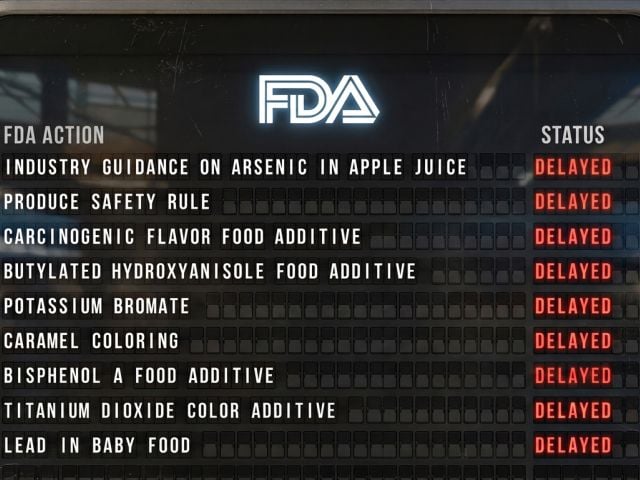
Five, the FDA has no plan to reconsider the safety of these colors or other toxic food chemicals any time soon and is not required to do so.
Unlike pesticides, the safety of which must be reconsidered by the EPA every 15 years, dyes are not periodically reviewed for safety by the FDA. In fact, 99% of new food chemicals are reviewed by food chemical companies, not the FDA, so most of the food chemicals we eat every day have either never been reviewed for safety by the FDA or have not been reviewed for many decades.
Several other chemicals that have been banned elsewhere and pose the risk of serious harms, even cancer, have been banned by other states. They might also be good candidates for action in Vermont, including BHA, BHT, propyl paraben and potassium bromate.
Three of these chemicals have been banned from all foods sold in California and West Virginia, and Indiana’s General Assembly just yesterday voted to remove all four from Indiana’s school foods.
While we are hopeful change is coming to the FDA, it’s not coming soon, if ever. Let’s do what the scientists say is best for our children, parents and teachers, and end the use of these toxic chemicals in food offered at school.