WASHINGTON – The Environmental Working Group has reached a settlement in its lawsuit alleging that Tyson Foods’ promises to reach “net-zero” greenhouse gas emissions by 2050 and sell “climate-smart” beef were not backed by sufficient actions to make those goals credible.
Under the settlement, Tyson will refrain from making these environmental claims for five years and cannot introduce new related claims unless they are supported by expert analysis and verified facts. The settlement was filed today in D.C. Superior Court.
It follows a separate settlement reached on November 10 between the New York attorney general’s office and JBS USA, the giant meat producer, which also agreed to stop making unsubstantiated claims about reaching net-zero greenhouse gas emissions.
JBS and Tyson together produce about 50% of the beef consumed in the United States. The settlements represent a positive step in efforts to protect consumers from false and misleading statements made by major beef corporations.
EWG is represented by Animal Legal Defense Fund, or ALDF, Earthjustice, Edelson PC and FarmSTAND in the suit filed under the District of Columbia Consumer Protection Procedures Act. Filed in September 2024, the suit accused Tyson of making “false or misleading” marketing claims targeting D.C. consumers concerned about climate change.
“This settlement reinforces the principle that consumers deserve honesty and accountability from the corporations shaping our food system,” said Caroline Leary, general counsel and chief operating officer at EWG. “The outcome makes clear that corporate climate pledges must be transparent, verifiable and rooted in real change.”
Significant victory
“This settlement is a significant milestone for advocates and consumers who demand honesty in climate-related marketing,” said Amanda Howell, Managing Attorney at ALDF.
“Tyson Foods, the second largest meat company in the world, has agreed to stop making climate and emissions claims unless those claims are substantiated by a third-party expert using credible science and an actual, achievable plan,” she added.
“ALDF will continue working to ensure that consumers who care about the climate crisis, sustainability, and the harmful environmental impacts of animal agriculture have access to truthful and non-misleading information,” said Howell.
“This settlement should be a clear signal to consumers to be cautious of major beef producers’ marketing their products as ‘climate-smart,’” said Carrie Apfel, Deputy Managing Attorney of Earthjustice’s Sustainable Food and Farming program.
“Industrial beef production emits vast amounts of greenhouse gases from every stage of the operation. Achieving meaningful emission reductions at this industrial scale would require corporations to make transparent, transformative changes — which we allege Tyson hasn’t shown,” said Apfel.
“Today’s resolution marks a crucial turning point in the fight against climate greenwashing,” said Kelsey Eberly, Senior Staff Attorney at FarmSTAND.
“Tyson Foods is the second-largest meat and poultry producer in the world, controls a fifth of the country’s beef, pork, and chicken — and has been estimated to produce nearly as much methane pollution as major oil companies. And now, it’s pulling down its climate claims,” said Eberly.
“With climate-forward policies weathering existential attacks, legal actions like this are increasingly critical to raise consumer awareness about the outsized impact conglomerates like Tyson have on our climate,” added Eberly.
Beef production’s climate impacts
Industrialized meat production generates tremendous volumes of climate-warming emissions at every stage of the process, from deforestation and overgrazing to feed production, and from cattle enteric and manure emissions to slaughter and distribution.
Tyson’s greenhouse gas emissions alone exceed those of Austria or Greece. Its beef production is responsible for 85% of the company’s emissions.
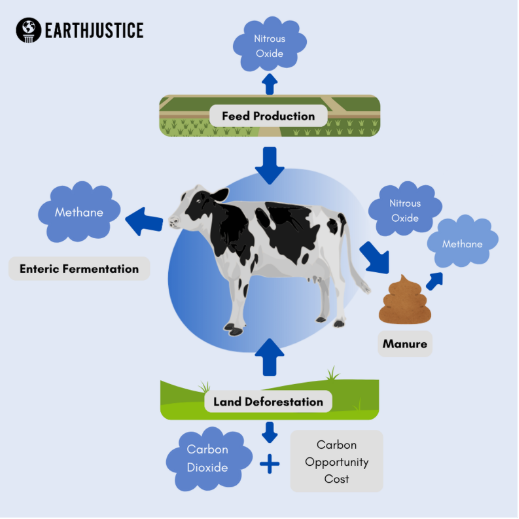
In 2022, enteric fermentation from beef cattle – their natural digestion process – accounted for about 18% of total U.S. methane emissions. Methane acts as a powerful greenhouse gas, with a global warming potential more than 80 times that of carbon dioxide over 20 years.
Manure management also contributes to both methane and nitrous oxide emissions. And through the use of fertilizers, feed production for beef cattle releases additional nitrous oxide, which has a global warming potential nearly 300 times that of carbon dioxide.
Deforestation and degradation of land for beef cattle production globally release carbon dioxide and also incur a carbon opportunity cost by precluding additional sequestration that would occur under alternative land use scenarios.
EWG’s lawsuit allegations
In its complaint, EWG alleged that studies show methane and nitrous oxide emitted by Tyson’s intensive beef production cannot be eliminated with existing or anticipated technology. EWG’s complaint alleged it is currently impossible for Tyson to cut enteric emissions without eliminating the cattle themselves, making the “net-zero” or “climate-smart” claims misleading.
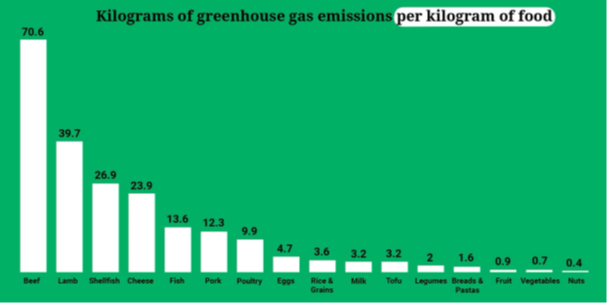
Industrially produced meat contributes significantly to climate emissions, and beef such as Tyson’s contributes far greater emissions than all other major food products.
Consumers increasingly seek products that are better for the planet. EWG’s complaint noted Tyson’s recognition that “a growing number of consumers are willing to pay a premium to eat beef and other foods with lower GHG [greenhouse gas] emissions,” that “[c]onsumers would be willing to pay at least 24% more for environmentally friendly sustainable options in retail,” and that “[i]ncreasing concern over climate change also may adversely impact demand for our products due to changes in consumer preferences.”
In an intentional effort to capitalize on consumer preferences for sustainable options, Tyson repeatedly told consumers on its website and in news releases over nearly four and a half years that it was committing to achieving “net-zero” emissions by 2050, and that it “sells climate-smart beef.”
As the lawsuit alleged, despite the enormous scale of Tyson’s industrial production and its GHG emissions, the company has taken little action toward achieving these commitments. It has fallen far short of offering anything close to substantiation for these claims, the suit alleged.
Rather, the complaint maintained, Tyson has spent less than 0.1% of its revenue on efforts to reduce its climate impact, mostly on research – $50 million dollars out of a total annual revenue of roughly $53 billion. Tyson spends about three times as much on advertising as it does on research.
###
The Environmental Working Group (EWG) is a nonprofit, non-partisan organization that empowers people to live healthier lives in a healthier environment. Through research, advocacy and unique education tools, EWG drives consumer choice and civic action.