
Thousands of U.S. schools are near farms where harmful pesticides may be sprayed, an EWG analysis finds. But some members of Congress want to block states and local governments’ right to warn parents and protect students from the health risks of pesticide spraying.
They’re looking to use the upcoming “skinny” farm bill as a vehicle to end the long-standing ability of state and local officials to safeguard people from the worst risks of pesticide spraying. If they succeed, it could undo existing rules and prevent any future protections.
Studies show that living near pesticide spraying is linked to harm to the respiratory system, increased risk of cancer and harm to the developing child, such as low birth weight and reduced IQ. Spraying creates dangers not just for kids at schools close to fields where pesticides are used, but the chemicals can also drift in the air to places located further away.
Federal government models show that pesticides sprayed from planes or powerful airblast sprayers can routinely drift roughly 300 feet from where they’re applied.
EWG’s analysis found 3,901 public elementary and middle schools within just 200 feet of a crop field where pesticides could be sprayed – close enough for harmful drift to reach classrooms and playgrounds.
Another 24,471 schools are within a quarter mile of a pesticide-treated crop field. Research shows that pesticides are often detected inside homes as far as a half mile from spraying.
Pesticide air monitoring has shown that some pesticides can travel miles from the application site. Evidence suggests that health harms such as pediatric cancers may be associated with pesticide applications up to 2.5 miles away.
Expanding the distance to this maximum range, 63,160 schools could be impacted, the majority of public elementary and middle schools in the country.
This analysis doesn’t account for public high schools or private schools. Nor does it include the thousands of public parks, playgrounds and ballfields that are near where children live and play.
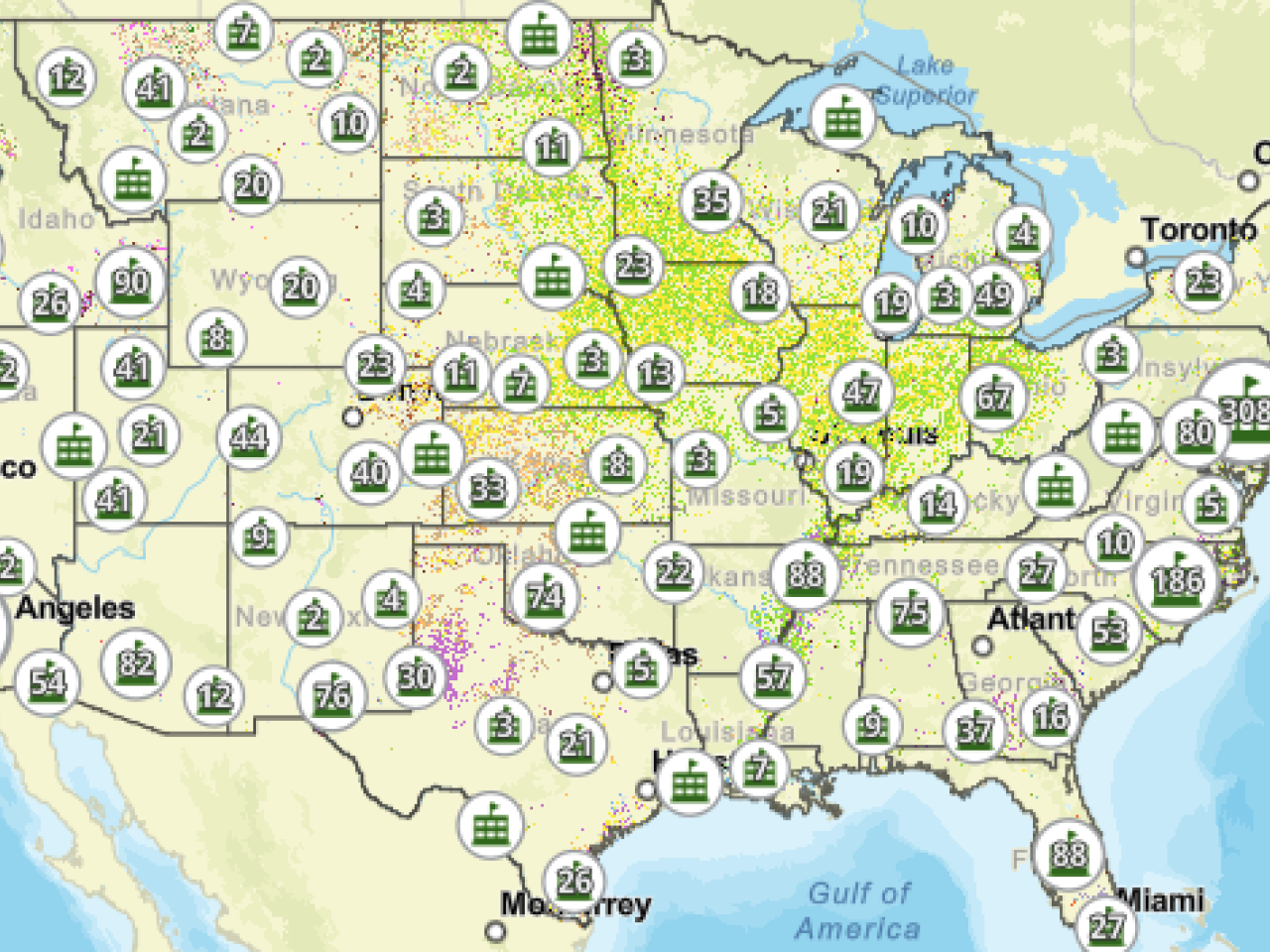
Many states, cities and counties have adopted legal standards to restrict pesticide spraying near schools, citing the risks they pose to children, whose bodies and brains are still developing. According to the American Academy of Pediatrics, children are especially susceptible to potential health problems from pesticides such as neurological and behavioral development, endocrine disruption and cancer.
More than 40 states – including Georgia, North Carolina, New York, Illinois and Texas – have adopted tough standards for how and when pesticides can be sprayed near schools.
California and Texas, for example, require school officials to use low-risk pesticides. Alabama and North Carolina ban crop dusting near schools. Many other states – including Arizona, Louisiana, Maine, Michigan and New Hampshire – have also placed buffer zones that restrict pesticide spraying around schools.
Illinois and other states require that alerts be posted on school grounds to tell students before or after spraying. Some states, including Kentucky, Minnesota and Nevada, require that parents be notified. Others, like Louisiana and Pennsylvania, require schools to track students who are sensitive to pesticides. Other states, including Georgia and New Mexico, limit the times when pesticides can be sprayed near schools.
Laws and rules designed to protect children from toxic pesticides don’t stop at the school fence. Many states, including Iowa and Kansas, have adopted laws that restrict pesticides from being sprayed in public parks used by children. Dozens of communities have adopted local ordinances to limit pesticide spraying in these parks.
Protecting farmworkers
State and local governments have also adopted pesticide standards to protect workers.
Some states, like California and Oregon, have restricted the use of certain pesticides, citing cancer risks – particularly for those who live near crop fields.
States such as North Carolina require additional clear labeling on toxic chemicals such as a skull and crossbones, as well as antidote information. Other states, including Florida, New York and Washington, have acted to protect workers by mandating warnings for farmworkers and landscapers, who use pesticides and farmers whose crops have been destroyed by drift.
And some workers who have been injured by pesticides have relied on state laws to seek justice for the harms they have suffered.
Blocking pesticide protections
Some members of Congress have introduced proposals to block, or preempt, state and local bans on spraying near schools.
Pesticide companies, including Bayer’s Monsanto, are supporting these proposals. These companies are trying to boost pesticide sales and limit court judgments that have been in favor of people who have been unknowingly harmed from pesticide use.
House Agriculture Committee Chairman Glenn “GT” Thompson (R-Pa.) has repeatedly said one of his priorities is acting on behalf of these large, foreign chemical companies. He should instead be listening to farmers, moms, and communities when they warn about how they can be hurt by exposure to pesticides.
Congress should drop this controversial language from any upcoming ‘skinny’ farm bill.
Lawmakers should side with the hundreds of state and local elected officials and the hundreds of health, education, labor and environmental organizations that stand for protecting state and local rights.