Displaying 4921 - 4944 of 8009
A rock and a hard place: Mercury pollution from common household products
This is a rather instructive story, I think: Since the angelically named Clear Skies Act of 2003 was enacted, mercury levels in bodies of water in Lincoln County, Maine have risen steadily. So, in...
Yes, mining can be even more polluting!
Recently, Newmont Mining was cleared of a pollution and environmental damage lawsuit in Buyat Bay in Indonesia. The judge found that there was not enough evidence to prove that Newmont polluted the...
If you can stomach it
Editorial pages across the country are ripping apart the Senate's recently passed version of the farm bill, much as they excoriated the House version of last summer. Under either bill, billions of...
More to flame retardants than PBDEs
If you follow these things, you've probably heard of the flame retardant chemicals PBDEs. They're in many electronics (possibly even that computer screen you're reading right now), and in the foam in...
Copperhill renewed
Stories of renewal come from the strangest places -- like, for example, The New York Times' travel section. This is a good one, and well timed. I, for one, could use a little hope today. Fifty years...
The once and future king?
It’s no secret California Attorney General Jerry Brown wants to return to the governor’s office he held from 1975 to 1983. But for a guy whose family name is synonymous with “Democrat†and is...
Making use of urban bounty
A friend visited from California a few weeks ago. Sitting on the couch in my apartment, he noticed the pomegranate sitting in my fruit bowl and smiled. "We've got more of those that we know what to do...
Google: Making green by being green
The thing about business is this: the goal is to make money. In fact, if a corporation does not act in its own best financial interest, it's legally liable to shareholders. That's a fact that often...
White House has a plan for consumer safety
The Bush administration will unveil a plan today to give the FDA and CPSC more authority over imports. Congress, you may know, is already considering what action to take on consumer safety; their plan...
SMM: The other part of the fish story
A few weeks ago, during the discussions around the industry-funded recommendations advising women to eat more fish, an important point was frequently raised (on this website and others): While we're...
Drop in aggressive crime parallels ban on leaded gasoline
It can be hard to prove the correlation between environmental exposures and health implications. Public health advocates who focus on environmental exposures, often speak about general health trends...
SMM: Well-oiled machine
I do not speak for the rest of the Enviroblog team when I say, I love bluegrass. I love the classic stuff and the new stuff, the ballads, the lightening-fast pickin'. . . Who knows, maybe I was from...
Envirohealth News: Home on the trash heap, and recycle your CFLs!
As the Santa Ana winds begin to die down and Southern Californians take stock of the damages, some in the media are noting the impact that global warming may have on wildfires. In the UK, the BBC asks...
Envirohealth in Blogs: Getting to the meat of things
A little light reading for your Wednesday. . . Liz at The Pump Handle looks at how the problems at Topps Meat managed to get past USDA inspectors, and as per usual it all comes down to money. While we...
Envirohealth News: Peak oil, drought, and (thank goodness) some environmental heroes
Greener parenting: Because "those cute little feet sure do make a big carbon footprint." Atlanta has less than a 90-day supply of water left, and so far there's no backup plan. German-based Energy...
SMM: Eco-intervention
Poor Lindsay Lohas. Once upon a time she was a careful environmentalist, but in the wake of fortune and fame, her eco-idealism has gone down the toilet. Will her friends be able to get her back on...
SMM: Return of the Sign-O-Matic
About a year ago, McDonald's thought it would be a good idea to put miniature Hummers in children's Happy Meals. About a year ago, EWG decided, "Wow, that's actually a really lousy idea." And so began...
Envirohealth News: Extra frog legs, knowing nanotech and more
New EPA regulations will "get the lead out" of drinking water. One more reason to ditch the bottle. More toy recalls for lead paint. Is anyone surprised? In LA, schools are being built by freeways...
Message to Congress: Don't leave organic behind
Having cereal for breakfast? Take your coffee with cream? Serving up a nice cold glass of milk to your child as she's on her way to school? Good then, I'm right on time. You may not choose organic...
Envirohealth News: Mercury-free fish may be in our future
Your environmental health news crib sheet. Something smells.There's " a veritable cocktail of dangerous and potentially dangerous volatile organic compounds" in your air fresheners, and a group of...
New Zealand's green farmer awards
In a step toward creating a peaceful union between farming and conservation, the Ballance Farm Environment Awards of New Zealand announced their acceptance of nominations for farmers who have done the...

EWG intern makes USA Today front page
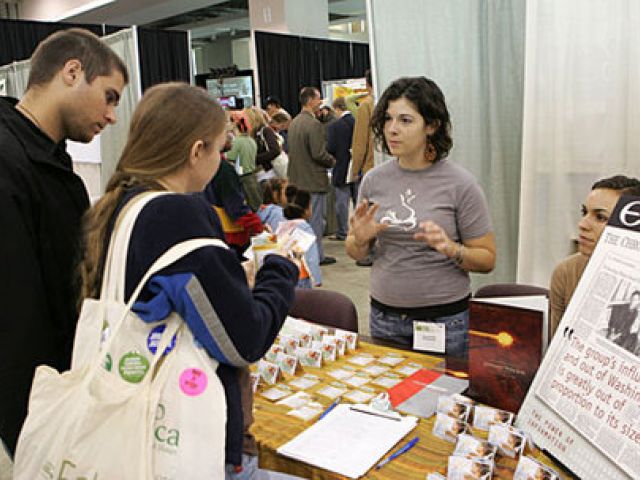
Today's USA Today profiles (on the front page no less) EWG intern Alex Wells. According to USAT Alex may be pretty typical of Generation Y. Research suggests she and other millennials — those in their...