Jump to:

Jump to:
EWG’s recommendation
Petroleum-based, synthetic dyes, including Blue Dye No. 1, Blue Dye No. 2, Green Dye No. 3, Red Dye No. 3, Red Dye No. 40, Yellow Dye No. 5 and Yellow Dye No. 6, are ingredients of concern.
EWG suggests limiting consumption of food that contains them.
Human and animal studies suggest artificial food dyes may affect behavior and learning, particularly in children. A 2021 assessment by the California Environmental Protection Agency’s Office of Environmental Health Hazard, or OEHHA, linked these dyes to adverse behavioral outcomes in children both with and without preexisting behavioral difficulties.
Animal studies have concluded that prenatal exposure to synthetic food dye mixtures can produce lasting changes in offspring behavior, including altered activity levels and measures of anxiety-like behavior and exploration.
Red 3 has been shown to cause cancer in laboratory animals exposed to high doses, prompting the Food and Drug Administration in 2025 to finally revoke its authorization of the dye for use in food.
Science analysis
What are artificial dyes and why are they added to foods?
Artificial dyes are added to processed foods to give them color, restore color lost during processing, and make them visually appealing.
Six synthetic food dyes are authorized for general use in U.S. food: Blue 1, Blue 2, Green 3, Red 40, Yellow 5 and Yellow 6. Red 3, another petroleum-derived synthetic dye, is currently being phased out.
| Ingredient name | Synonym | European number |
|---|---|---|
| Red 40 | Allura Red AC | E129* |
| Red 3 | Erythrosine | E127 |
| Yellow 5 | Tartrazine | E102* |
| Yellow 6 | Sunset Yellow FCF | E110* |
| Blue 1 | Brilliant Blue FCF | E133 |
| Blue 2 | Indigotine / Indigo Carmine | E132 |
| Green 3 | Fast Green FCF | E143 (Not authorized in the EU) |
* Must carry a warning label in the EU.
Where are artificial dyes found in foods?
Artificial dyes are most commonly added to candy, baked goods, desserts, beverages, breakfast cereal and other snacks.
They are found in 23,312 of the 172,081 foods and beverages added to EWG’s Food Scores between 2023 and 2025.
The 15 food categories with the most products containing food dyes (by supermarket shelf):
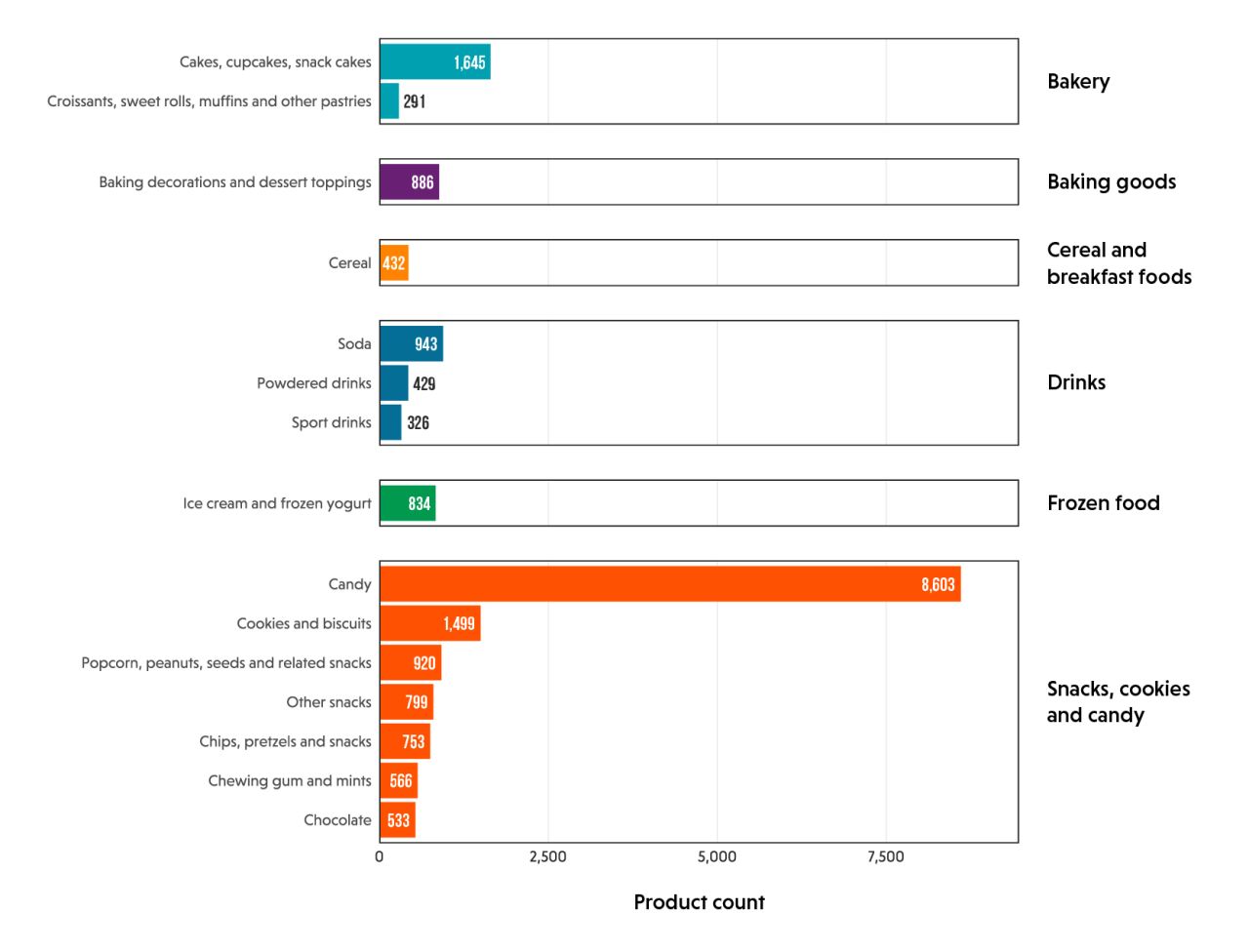
Source: EWG’s Food Scores. Label created between January 2023 and October 2025.
What is the regulatory status of artificial dyes?
In 2025, the FDA revoked the use of Red 3 in food products and oral medication on the basis of the Delaney Clause, which bans authorization of a food or color additive found to induce cancer in humans or animals. Red 3 must be phased out of all food products by January 15, 2027.
In 2025, the FDA announced plans to work with manufacturers to phase out the remaining six artificial dyes in foods by the end of 2027.
Bills have been enacted in California, Utah, Arizona, Virginia and other states to ban Blue 1, Blue 2, Green 3, Red 40, Yellow 5 and Yellow 6 in food sold in public schools. And in 2025, West Virginia enacted a bill to ban these artificial dyes statewide.
Food containing Red 40, Yellow 5 or Yellow 6 sold in the European Union must carry a warning label stating the dye “may have an adverse effect on activity and attention in children.” The EU doesn’t allow the use of Green 3 as a food additive.
In 2025, EWG supported the Ban Harmful Food Dyes Act, a bill in Congress which aimed to revoke approval for use of Blue 1, Blue 2, Citrus Red No. 2, Green 3, Orange B, Red 3, Red 40, Yellow 5, Yellow 6, titanium dioxide and any additive similar in chemical makeup. The FDA revoked authorization for Orange B in 2026, and proposed revoking authorization for Citrus Red 2.
Are foods containing artificial dyes ultra-processed?
Industrially synthesized ingredients such as artificial food dyes are common in ingredients defined as ultra-processed food, or UPF, ingredients in the Nova framework (Monteiro et al., 2019).
Under a recent California law defining UPF, food containing artificial dyes is considered UPF (Real Food, Healthy Kids Act, 2025).
Are artificial dyes allowed in organic foods?
Under Agriculture Department organic standards, synthetic substances are banned in certified organic foods.
What are the potential health harms associated with artificial dyes?
Thorough review by the OEHHA found artificial food dyes are linked to adverse behavioral outcomes in children both with and without preexisting behavioral disorders (OEHHA, 2021), which is of particular importance since foods containing artificial food dyes are typically marketed to children (Dunford et al. 2025).
Although mixtures of all seven food dyes produced observed effects across studies, the most evidence of toxicity comes from studies of Red 3, Red 40 and Yellow 5. Reviewed studies support the evidence of their behavior and learning effects.
The research found changes in the behavior and learning of children exposed to artificial food dyes, both when the colors were added and eliminated from their diets.
This assessment of human and animal studies showed that because of outdated toxicity data, current allowable daily intake values do not sufficiently protect children from harm.
In one study, Yellow 5 was found to increase behavioral changes such as irritability, sleeplessness and decreased attention span in a dose-dependent manner in children (Rowe & Rowe, 1994).
In animal studies, developmental effects were observed in rodents exposed to artificial food coloring in utero. A series of studies that exposed pregnant mice to a mixture of artificial dyes and followed their offspring to adulthood observed long-term neurobehavioral changes.
Exposed offspring exhibited significant changes in movement and exploratory behaviors and altered anxiety profiles (Doguc et al., 2013, 2015, 2019). In one of these studies, these effects occurred with doses relevant to human exposure.
The neurobehavioral effects of artificial food dyes are believed to be caused by the ability of the dyes to bind to certain proteins and affect neurotransmitter pathways. When studying learning and behavior changes in rodents, researchers found that exposure during pregnancy can lead to altered expression of receptors that control memory (Ceyhan et al., 2013).
Red 3 was linked to cancer when it was observed to induce thyroid tumors in rats (Hiasa et al., 1988). Separate laboratory research found Red 3 can interfere with thyroid hormone signaling and estrogen-related pathways in human breast cancer cells, raising questions about its potential to disrupt hormones (Dees et al., 1997).
A 2015 study of human lymphocytes observed damage to genetic material exposed to Yellow 5 (Soares et al., 2015).
Another found that long-term consumption of this dye, even at levels established as safe, significantly changed how epigenetic genes are regulated in multiple mouse organs, suggesting the potential for developing cancer and behavioral effects (Zand et al., 2023).
Other research has linked certain food dyes, such as Yellow 5 and 6, to disruption of the human gut microbiome (Elder et al., 2023), and Red 40 to colitis in animal studies (He et al., 2021; Kwon et al., 2022).
Although research is limited on how artificial food dyes affect human health, some epidemiological evidence suggests that consumption of foods with both natural and artificial dyes is associated with an increased incidence of Type 2 diabetes (Shah et al., 2026).
Uncertainties/where more research is needed
From its 2021 report, the OEHHA identified important gaps in research on synthetic food dyes, including limited understanding of individual susceptibility, long-term developmental effects, absorption and metabolism, and differences in exposure and effects across population groups.
It also noted that current FDA acceptable daily intakes are based largely on decades-old studies that were not designed to assess behavior and learning effects.
The OEHHA nevertheless concluded the available human and animal evidence supports behavioral effects in some children and called for modern, dye-specific research to set exposure levels that adequately protect children’s health.
More details about artificial dyes
Red 40, Yellow 5 and Yellow 6 account for most of the dyes used in the U.S. market.
Synthetic food dyes can contain manufacturing-related impurities, including carcinogenic compounds, that raise potential health concerns. A review by the Center for Science in the Public Interest called attention to p-cresidine as one potential carcinogenic impurity in Red 40 and benzidine and 4-aminobiphenyl in Yellow 5 and Yellow 6. Benzidine is classified as carcinogenic by the International Agency for Research on Cancer.
Orange B, an artificial color used only to color sausage casings, was “abandoned by industry” and is no longer approved for use as of September 2026. Since it is no longer being used, it doesn’t need to be evaluated.
Citrus Red 2 is allowed to be used only to restore the orange color to the skin of oranges that lose their color, but is also abandoned by industry.
Cited resources
Global health and regulatory agencies
- Regulation (EC) No 1333/2008 of the European Parliament and of the Council of 16 December 2008 on food additives. (2008). Official Journal of the European Union, L 354, 16–33. http://data.europa.eu/eli/reg/2008/1333/oj
Comprehensive reviews and frameworks
- Monteiro, C.A., Cannon, G., Levy, R.B., Moubarac, J., Louzada, M.L., Rauber, F., Khandpur, N., Cediel, G., Neri, D., Martinez-Steele, E., Baraldi, L.G., & Jaime, P.C. (2019). Ultra-processed foods: What they are and how to identify them. Public Health Nutrition, 22(5), 936–941. https://doi.org/10.1017/s1368980018003762.
- Office of Environmental Health Hazard Assessment. (April 2021). Health effects assessment: Potential neurobehavioral effects of synthetic food dyes in children. California Environmental Protection Agency, Children’s Environmental Health Center. https://oehha.ca.gov/media/downloads/risk-assessment/report/healthefftsassess041621.pdf
Legislation
- Arizona House Bill No. 2164, 57th Leg., 1st Reg. Sess., Ariz. (2025). https://legiscan.com/AZ/text/HB2164/2025
- Ban Harmful Food Dyes Act, H.R. 5027, 119th Cong. (2025). https://www.congress.gov/bill/119th-congress/house-bill/5027/all-info
- California Assembly Bill No. 2316, Chapter 914, Cal. Stat. (2024). https://leginfo.legislature.ca.gov/faces/billNavClient.xhtml?bill_id=202320240AB2316
- Real Food, Healthy Kids Act, Assemb. Bill 1264, Chapter 467 (Cal. 2025). https://leginfo.legislature.ca.gov/faces/billTextClient.xhtml?bill_id=202520260AB1264.
- Food and Drug Administration. (2025, January 15). FD&C Red No. 3. https://www.fda.gov/industry/color-additives/fdc-red-no-3
- FDA. (April 22, 2025). HHS, FDA to phase out petroleum-based synthetic dyes in nation’s food supply. https://www.fda.gov/news-events/press-announcements/hhs-fda-phase-out-petroleum-based-synthetic-dyes-nations-food-supply
- Utah House Bill No. 402, General Session, Utah State Legislature (2025). https://legiscan.com/UT/text/HB0402/2025
- Virginia Senate Bill No. 1289, Chapter 222, Va. Acts (2025). https://legiscan.com/VA/text/SB1289/id/3191585/Virginia-2025-SB1289-Chaptered.html
- West Virginia House Bill No. 2354, Chapter 206, W.Va. Acts (2025). https://legiscan.com/WV/text/HB2354/id/3177443/West_Virginia-2025-HB2354-Enrolled.html
Specific health impact studies
- Ceyhan, B. M., Gultekin, F., Doguc, D. K., & Kulac, E. (2013). Effects of maternally exposed coloring food additives on receptor expressions related to learning and memory in rats. Food and chemical toxicology : an international journal published for the British Industrial Biological Research Association, 56, 145–148. https://doi.org/10.1016/j.fct.2013.02.016
- Dees, C., Askari, M., Garrett, S., Gehrs, K., Henley, D., & Ardies, C. M. (1997). Estrogenic and DNA-damaging activity of Red No. 3 in human breast cancer cells. Environmental health perspectives, 105 Suppl 3(Suppl 3), 625–632. https://doi.org/10.1289/ehp.97105s3625
- Doguc D.K., Ceyhan B.M., Ozturk M., Gultekin F. 2013. Effects of maternally exposed colouring food additives on cognitive performance in rats. Toxicol Ind Health 29:616623.
- Doguc D.K., Aylak F., Ilhan I., Kulac E., Gultekin F. 2015. Are there any remarkable effects of prenatal exposure to food colourings on neurobehaviour and learning process in rat offspring? Nutr Neurosci 18:12-21.
- Doguc D.K., Deniz F., Ilhan I., Ergonul E., Gultekin F. 2021. Prenatal exposure to artificial food colorings alters NMDA receptor subunit concentrations in rat hippocampus. Nutr Neurosci:1-11.
- Elder, R., Vancuren, S. J., Botschner, A. J., Josephy, P. D., & Allen-Vercoe, E. (2023). Metabolism of azo food dyes by bacterial members of the human gut microbiome. Anaerobe, 83, Article 102783. https://doi.org/10.1016/j.anaerobe.2023.102783
- He, Z., Chen, L., Catalan-Dibene, J., Lafaille, J. J., Furtado, G. C., & Lira, S. A. (2021). Food colorants metabolized by commensal bacteria promote colitis in mice with dysregulated expression of interleukin-23. Cell Metabolism, 33(7), 1358–1371.e5. https://doi.org/10.1016/j.cmet.2021.04.015
- Hiasa, Y., Ohshima, M., Kitahori, Y., Konishi, N., Shimoyama, T., Sakaguchi, Y., Hashimoto, H., Minami, S., & Kato, Y. (1988). The promoting effects of food dyes, erythrosine (Red 3) and rose bengal B (Red 105), on thyroid tumors in partially thyroidectomized N-bis(2-hydroxypropyl)nitrosamine-treated rats. Japanese Journal of Cancer Research, 79(3), 314–319. https://doi.org/10.1111/j.1349-7006.1988.tb01593.x
- Kwon, Y.H., Banskota, S., Wang, H. et al. Chronic exposure to synthetic food colorant Allura Red AC promotes susceptibility to experimental colitis via intestinal serotonin in mice. Nat Commun 13, 7617 (2022). https://doi.org/10.1038/s41467-022-35309-y
- Rowe, K. S., & Rowe, K. J. (1994). Synthetic food coloring and behavior: A dose response effect in a double-blind, placebo-controlled, repeated-measures study. The Journal of Pediatrics, 125(5), 691–698. https://doi.org/10.1016/S0022-3476(06)80164-2
- Sanam Shah, Anaïs Hasenböhler, Guillaume Javaux, Marie Payen de la Garanderie, Fabien Szabo de Edelenyi, Paola Yvroud, Cédric Agaësse, Alexandre De Sa, Inge Huybrechts, Fabrice Pierre, Marc Audebert, Xavier Coumoul, Chantal Julia, Emmanuelle Kesse-Guyot, Benjamin Allès, Valérie Deschamps, Serge Hercberg, Benoit Chassaing, Emmanuel Cosson, Sopio Tatulashvili, Mélanie Deschasaux-Tanguy, Bernard Srour, Mathilde Touvier; Food Coloring Additives and Incidence of Type 2 Diabetes in the NutriNet-Santé Prospective Cohort. Diabetes Care 20 May 2026; 49 (6): 1067–1077. https://doi.org/10.2337/dc25-2727
- Soares, B. M., Araújo, T. M. T., Ramos, J. A. B., Pinto, L. C., Khayat, B. M., Bahia, M. O., Montenegro, R. C., Burbano, R. M. R., & Khayat, A. S. (2015). Effects on DNA repair in human lymphocytes exposed to the food dye tartrazine yellow. Anticancer Research, 35(3), 1465–1474. https://ar.iiarjournals.org/content/35/3/1465
- Zand, A., Enkhbilguun, S., Macharia, J. M., Budán, F., Gyöngyi, Z., & Varjas, T. (2023). Tartrazine Modifies the Activity of DNMT and HDAC Genes-Is This a Link between Cancer and Neurological Disorders?. Nutrients, 15(13), 2946. https://doi.org/10.3390/nu15132946
Other
- Dunford, E. K., Galligan, T. M., Taillie, L. S., & Musicus, A. A. (2025). All the Colors of the Rainbow: Synthetic Dyes in US Packaged Foods and Beverages in 2020. Journal of the Academy of Nutrition and Dietetics, 125(9), 1207-1217.e9. https://doi.org/10.1016/j.jand.2025.05.007
- Simon, J.E., Decker, E.A., Ferruzzi, M.G., Giusti, M.M., Mejia, C.D., Goldschmidt, M. and Talcott, S.T. (2017), Establishing Standards on Colors from Natural Sources. Journal of Food Science, 82: 2539-2553. https://doi.org/10.1111/1750-3841.13927