Overview
- Agriculture produces around 10% of U.S. greenhouse gas emissions, and the sector’s emissions are rising.
- Under current policies, that 10% could jump to between 18% and 41% by 2050.
- The next farm bill should prioritize and fully fund regenerative agriculture practices to stop the sector from becoming the largest source of emissions.
Agriculture could become the nation’s leading producer of greenhouse gases by 2050.
Most other sectors of the economy, especially transportation and electricity, are expected to reduce their greenhouse gas emissions dramatically in the coming decades. That decline is mostly due to voluntary industry efforts and changing technology.
Agriculture’s climate pollution is driven overwhelmingly by nitrous oxide and methane. Nitrous oxide accounts for 52% of agricultural greenhouse gas emissions, while methane accounts for another 46%. And the sector’s emissions keep rising – they’re projected to go up a quarter of a percent every year through mid-century.
That should be a wake-up call for Congress.
Agricultural conservation practices – like riparian forest buffers, tree establishment, diversified crop rotations and nutrient management – can help reduce climate emissions or store carbon, so agriculture doesn’t become the biggest source of emissions.
These practices also have other benefits, such as reducing air pollution and protecting waterways.
But the billions of dollars both the House and Senate farm bills propose to cut from federal conservation programs would make it harder for farmers to reduce greenhouse gas emissions.
Congress, through the farm bill, should maintain conservation program funding, and prioritize the money for regenerative practices, instead of continuing to send so much money to structural practices that bring little, if any, climate emissions reductions.
Agriculture’s growing share of emissions
Agriculture is responsible for at least 10% of annual U.S. greenhouse gas emissions. When combined with emissions from fertilizer production, the sector’s share is even higher.
Climate models show that if the sector’s emissions increase slightly while emissions from other sectors fall, as projected, agriculture’s share of U.S. emissions will grow.
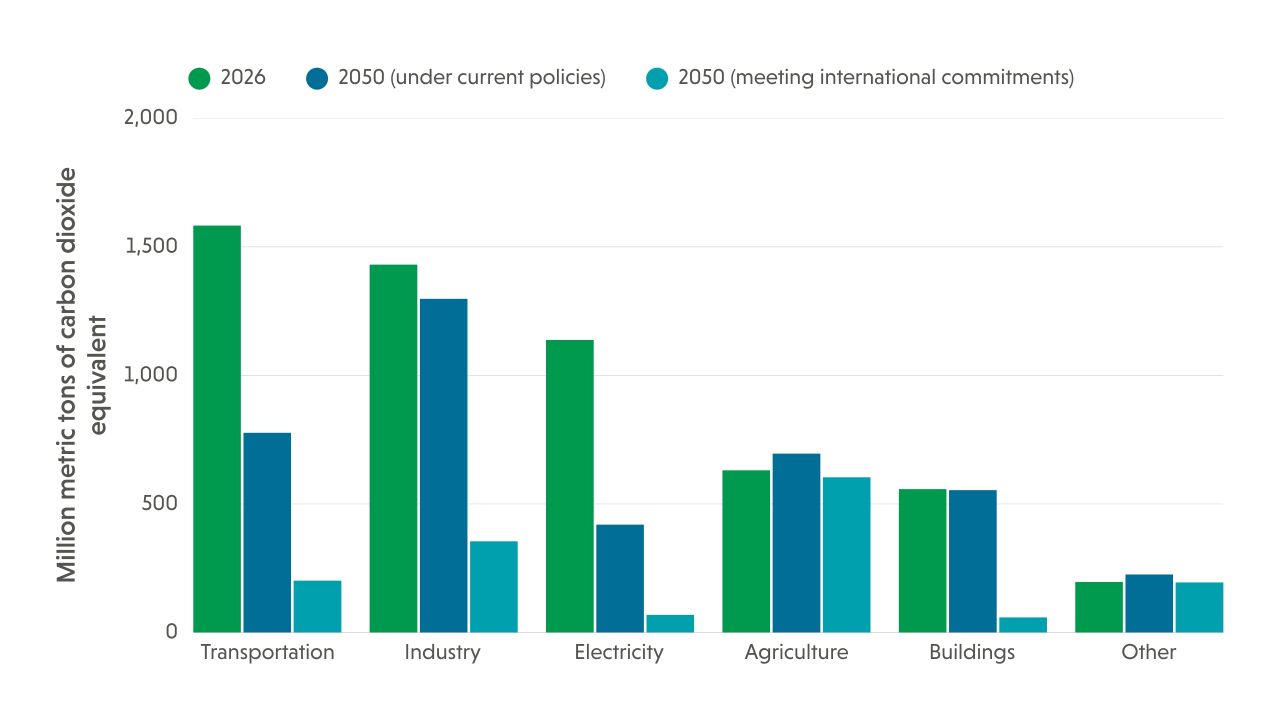
Agriculture ranks fourth among U.S. economic sectors for greenhouse gas emissions, behind transportation, industry and electricity and ahead of buildings and “other” sources.
But that ranking is unlikely to last.
Under policies in place today, agriculture’s share of emissions is expected to almost double by 2050, from 10% to 18%. Agriculture would move up to being the third largest greenhouse-gas-producing sector, after industry and transportation.
But the U.S. has previously made international climate commitments, including through the Paris Agreement, that have led to federal rules aimed at reducing greenhouse gases from most other sectors, including industry and transportation.
Even though the Trump administration – in both the first and second terms – withdrew from the Paris climate pact, the industry and transportation sectors are still rapidly reducing their emissions.
There are no broad federal greenhouse gas rules in place to force cuts in agriculture’s emissions. As industry, transportation and other sectors lower their overall emissions, agriculture’s share rises – unless the sector also acts to cut emissions.
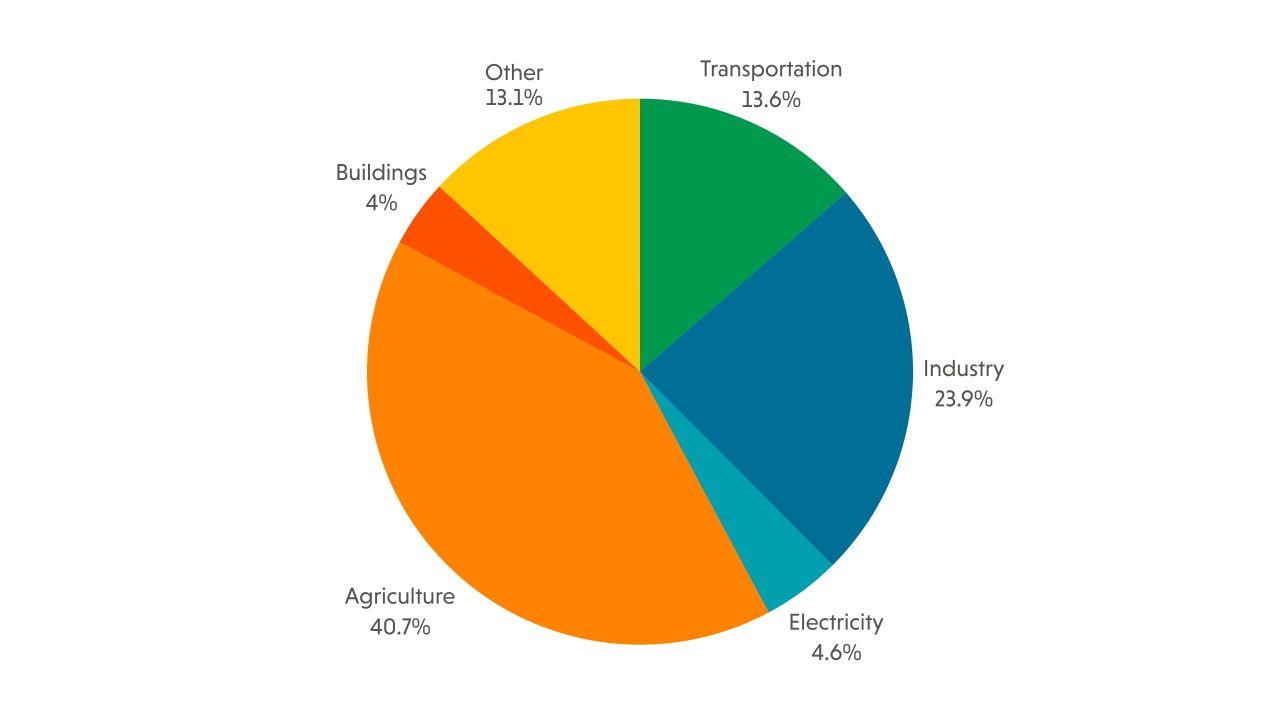
Under the scenario in which the U.S. reduces total emissions to levels agreed on in the Paris Agreement, the agriculture sector would make up 41% of total U.S. emissions in 2050. In this scenario, agriculture would be the economic sector producing the most greenhouse gas emissions, because the other sectors would severely cut their emissions. (See Figure 1.)
Figure 1. U.S. emissions by economic sector in 2026, and predicted emissions in 2050 under two scenarios
Source: EWG, using data from Energy Innovation’s Energy Policy Simulator.
Agriculture must reduce its emissions to avoid becoming the No. 1 source of U.S. climate emissions. (See Figure 2.) Scientists warn that if emissions from agriculture don’t go down, the worst impacts of the climate crisis will be inescapable.
Figure 2. If the U.S. follows its international commitments in other sectors, agriculture could top 40% of emissions by 2050
Source: EWG, using data from Energy Innovation’s Energy Policy Simulator.
Nitrous oxide and methane are agriculture’s main climate emissions
Agricultural soil management is the main driver of the sector’s nitrous oxide emissions, particularly the widespread use of fertilizer on crops like corn. Microbes in soil turn nitrogen from fertilizer and manure into nitrous oxide.
Even though nitrous oxide makes up a small share of total U.S. greenhouse gas emissions, it is a potent greenhouse gas. Nitrous oxide stays in the atmosphere for over 100 years and has a global warming potential 273 times more powerful than carbon dioxide.
Global nitrous oxide emissions grew by 40% between 1980 and 2020, and they are expected to increase another 30% between 2020 and 2050. Corn production makes up over half of all nitrous oxide emissions from agriculture.
Nitrous oxide does not just contribute to climate change; it also depletes the ozone layer. And ammonia nitrous oxides can form with other compounds to create particulate matter, with exposure leading to premature deaths.
Methane makes up the second largest share of greenhouse gas emissions from U.S. agriculture. Most agricultural methane emissions come from livestock. Enteric fermentation from beef and dairy cattle – their natural digestion process – accounts for about 25% of total U.S. methane emissions.
Manure management also contributes to both methane and nitrous oxide emissions, making up 9% of total U.S. methane emissions and 4% of total nitrous oxide emissions.
Methane does not stay in the atmosphere as long as carbon dioxide or nitrous oxide, but it has a global warming potential 28 times that of carbon dioxide over 100 years.
Regenerative agriculture practices can reduce emissions
Conservation practices implemented on farm fields can help to lower agriculture’s greenhouse gas emissions.
A 2022 report from the Boston Consulting Group and the Walton Family Foundation found that practice changes could slash greenhouse gas emissions from farming by almost 22%.
The report showed emissions could go down as a result of changes in fertilizer applications, tillage practices, grazing management, the use of cover crops, livestock feed additives, soil amendments and the targeted use of trees, among other practices.
EWG found in a 2025 analysis that many conservation practices can reduce farming’s greenhouse gas emissions. Even if they are adopted on only a small number of acres, they can have a big climate impact.
The conservation practices applied to Midwest corn acres that would most lower climate emissions are riparian forest buffers, tree or shrub establishment, hedgerow planting and windbreak establishment.
Other practices, including no-tillage, cover crops, and diversifying crops so there is a conservation crop rotation, would also reduce climate emissions.
But federal conservation program funding needs to be prioritized for practices that help farmers reduce climate emissions and adapt to extreme weather conditions tied to intensifying climate change.
EWG has identified a list of regenerative agriculture practices that decrease a farm’s greenhouse gas emissions and increase climate resilience.
Farmers can receive funding to implement these regenerative practices from the Agriculture Department’s Environmental Quality Incentives Program, or EQIP, one of the largest federal conservation programs.
But EQIP spending must be reformed. In 2025, only $660.9 million from EQIP, or 39% of all payments from the program, went to farmers for practices on EWG’s regenerative practice list. Only four of the top 10 paid practices were regenerative: cover crops, brush management, forest stand improvement, and pasture and hay planting.
Prioritizing funding
Six of the 10 most funded practices that were not regenerative were structural, building or equipment practices, which together received $427.1 million. These are practices like irrigation pipelines and animal waste storage facilities, which rarely benefit the climate.
Farmers collected hardly any money for some of the conservation practices that are the best at reducing emissions. Two practices that would generate substantial emissions reductions on Midwest corn acres – riparian forest buffer and hedgerow planting – received only $423,000 and $735,000 from EQIP nationally in 2025, respectively.
More conservation funding must be prioritized for regenerative practices that have climate benefits. Adoption of more of these practices could slow the growth of agriculture's greenhouse gas emissions so the sector does not produce the largest share of U.S. emissions by 2050.
The versions of the farm bill proposed by the House and Senate cut conservation spending by billions of dollars, including reducing funding for EQIP.
If these cuts were to go into effect, they would hurt farmers and the climate.