Millions of cropland and pasture acres in the 13-state Mississippi River Critical Conservation Area, or MRCCA, lie within flood plains at greater risk of climate-driven extreme weather like flooding or excessive rainfall. Yet federal farm policies aren’t doing enough to help farmers in these vulnerable areas enhance needed resilience to worsening climate threats.
Two of the most important Department of Agriculture farm programs, in particular, fall short of providing farmers critical assistance in climate adaptation.
The first, the USDA’s federal crop insurance program, sent almost $11.4 billion to farmers in this region between 2017 and 2024 for flooding and excess precipitation, representing 50% of total program spending. But the program does not encourage farmers to adapt to extreme weather.
The second, a department conservation program called the Environmental Quality Incentives Program, or EQIP, can do a better job of helping farmers become more resilient. Yet only $1.6 billion went to farmers in MRCCA counties over the same period from this program. Just 46% of the funding went toward climate resilience practices, a substantially smaller amount than crop insurance payments.
And a sizable share of EQIP spending goes to farmers for structural, equipment and facility practices instead of climate-smart practices that promote resilience.
The crop insurance program’s costs are expected to increase dramatically throughout the U.S. because of climate change. New research shows that crop insurance claims for corn are estimated to increase 29% by 2050.
Crop insurance funding for flooding and excess rain is much greater than funding for conservation practices, especially climate smart and resilience practices. And yet, more money for conservation practices that improve adaptation could reduce the costs of crop insurance. Implementing climate resilient practices, including diversifying crops, can also help cut nitrogen and phosphorus pollution from farms.
Reforms to both programs could better support farmers in increasing resilience to extreme weather.
Millions of acres of crop and pasture land are in MRCCA flood plains
The MRCCA is one of eight U.S. regions covered by the USDA’s Regional Conservation Partnership Program, created in the 2014 Farm Bill. The program encourages stakeholders in those areas to pursue common natural resource goals while maintaining or improving agricultural productivity.
The MRCCA has millions of environmentally sensitive acres that are vulnerable to the climate crisis. Flood plains are more likely to experience runoff and therefore to contribute nitrogen and phosphorus pollution to waterways. This contamination can then pollute drinking water with cancer-causing nitrates, and grow algae blooms in recreational water.
Precipitation has already increased in the MRCCA and it is expected to go up further due to climate change. Between 1980 and 2025, 45 flooding events cost over $1 billion each in the U.S.
The MRCCA region saw billion-dollar floods in 17 of those years.
The Fifth National Climate Assessment showed that annual precipitation has already increased in the region and will continue to increase, which will lead to more floods and large water runoff events within the region.
Increased precipitation makes farming in flood plains far riskier. During heavy rain events, cropland and pasture within these areas are more prone to flooding than land outside flood zones.
Flooding can destroy crops in the flood year while also causing soil to be taken from the land or depositing contaminated soil from elsewhere on to the land. Both scenarios can harm the affected farmland well into the future.
Farmland in flood plains is not just vulnerable to the effects of climate change. It can also be a hot spot of spikes in greenhouse gas emissions. Up to a certain point, higher levels of soil moisture contribute to greater cropland emissions of the greenhouse gas nitrous oxide. Because of this, cropland acres in flood plains are likely to be nitrous-oxide-producing hotspots, since they are more likely to have higher levels of soil moisture than cropland located outside a flood plain.
Agricultural conservation practices implemented on farmland in flood plains can help mitigate climate change and improve climate resilience, as well as reducing nutrient pollution in water. Practices such as cover crops, reducing tillage, crop diversification and buffer strips can help make farms more resilient to flooding, along with reducing greenhouse gas emissions and decreasing nutrient pollution of water.
There are over 46.7 million acres of land within the 100-year flood plain in the 1,047 counties that make up the MRCCA, with 18.1 million of those flood plain acres serving as crop or pasture land.
The Federal Emergency Management Agency defines the 100-year flood plain as containing land that has a 1% chance of flooding in a year. The map below shows all the counties that make up the MRCCA, along with the number of cropland acres in the flood plain in each county.
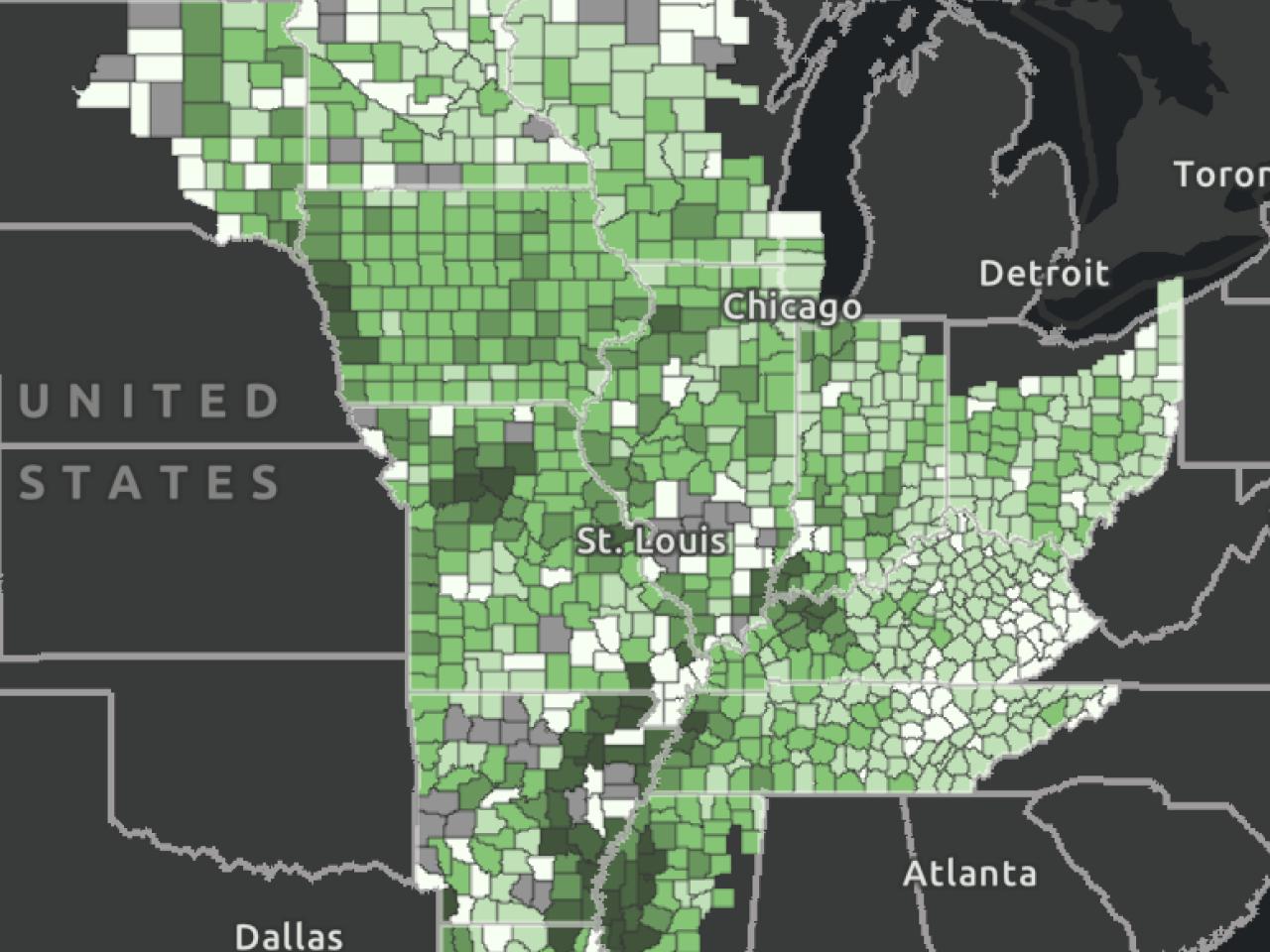
This is a map of the 1,047 counties in the Mississippi River Critical Conservation Area. The colors on the map represent the number of acres of crop or pasture land in each county that is also within the 100-year flood plain.
Almost all the MRCCA counties – 95% – have at least some crop or pasture land in the flood plain and are vulnerable to extreme rain.
Butler County, Mo., and Washington County, Miss., are the two counties with the most cropland in the flood plain. Butler has over 175,000 crop and pasture acres in the flood plain, and Washington has more than 172,000 acres.
Missouri, Iowa and Arkansas are the MRCCA states with the most crop and pasture land in the flood plain, each with over 2 million acres. These states alone account for 41%of all cropland in the region’s flood plain. (See Figure 1.)
Figure 1. States and the amounts of crop and pasture acres in the 100-year flood plain in the MRCCA counties.
| State | Acres of crop and pasture in flood plain | Percent of total crop/pasture acres in flood plain | Rank of acres of crop/pasture in flood plain in MRCCA counties |
| Missouri | 2,756,993 | 15% | 1 |
| Iowa | 2,478,460 | 14% | 2 |
| Arkansas | 2,182,286 | 12% | 3 |
| Illinois | 1,887,810 | 10% | 4 |
| Mississippi | 1,766,671 | 10% | 5 |
| Louisiana | 1,518,258 | 8% | 6 |
| Indiana | 1,255,546 | 7% | 7 |
| Kentucky | 1,154,970 | 6% | 8 |
| Tennessee | 1,092,796 | 6% | 9 |
| South Dakota | 632,002 | 3% | 10 |
| Ohio | 581,374 | 3% | 11 |
| Wisconsin | 466,134 | 3% | 12 |
| Minnesota | 360,897 | 2% | 13 |
| Total | 18,134,197 |
Source: EWG, from USDA National Agricultural Statistics Service Cropland Data Layer, and FEMA Flood Maps
Crop insurance sends billions to farmers
When a farmer has a reduction in crop yield or revenue (depending on the type of policy), they can receive a payment, or indemnity, from the federal Crop Insurance Program. Indemnities are paid out from the total pool of premium money. On average, taxpayers pay 63% of the premiums, while farmers pay 37%.
The “cause of loss” is the main reason for a reduction in crop yield or revenue that triggers a crop insurance payment. Causes of loss include weather-related triggers like excess precipitation, and other factors, such as decreases in crop prices. Between 2017 and 2024, for all causes of loss, farmers in the MRCCA collected more than $22.7 billion through the federal crop insurance program.
The USDA reports crop insurance payments at the county level only, so it’s impossible to find out how much funding goes to farms within 100-year flood plains in particular. It’s possible only to see payments to farmers in the MRCCA counties.
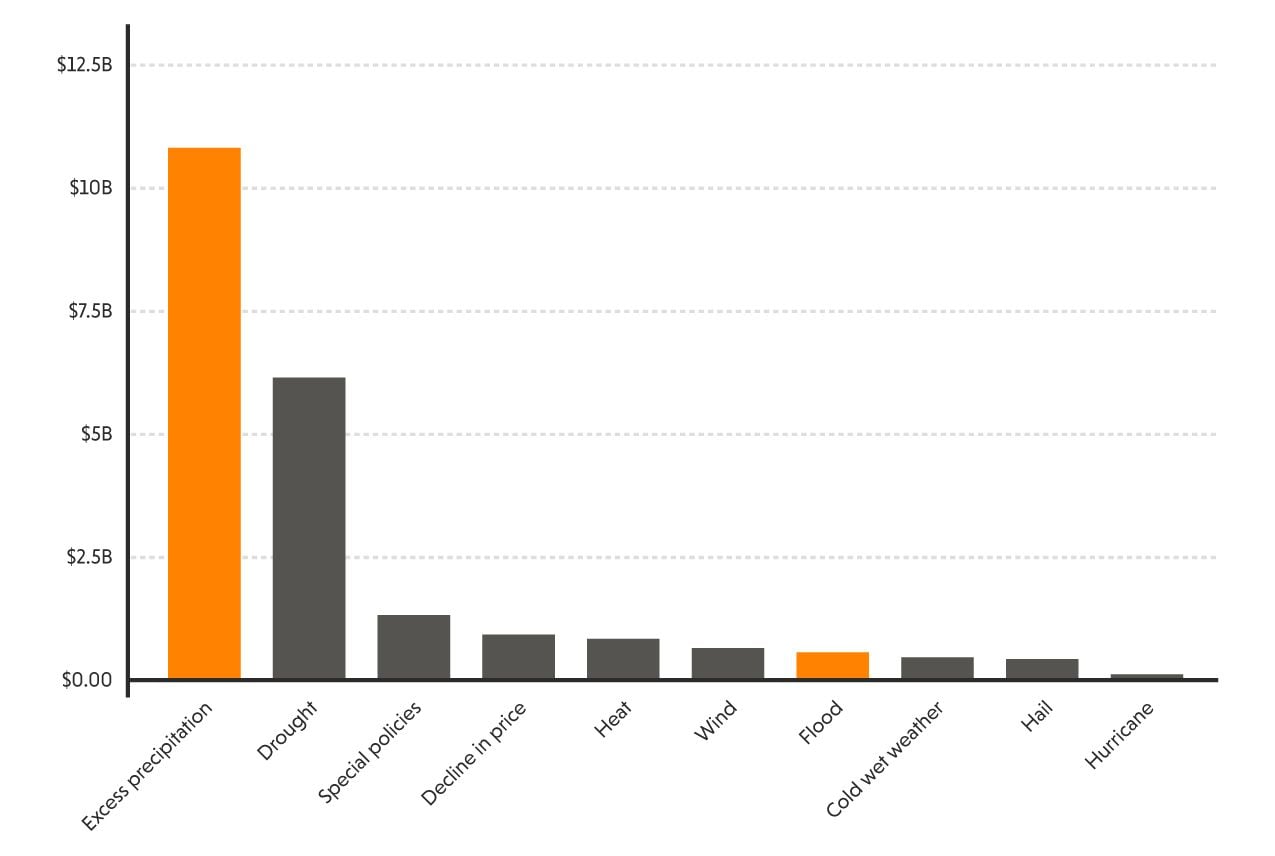
And between 2017 and 2024, they received substantial payments for weather-related losses – $559.3 million for flood damage and $10.8 billion for losses tied to excess precipitation.
Excess precipitation generated the most payments out of all causes of loss in the region. Payments amounted to almost $4.7 billion more than the second-largest cause of loss. And flooding was the seventh largest cause of loss. (See Figure 2.)
Figure 2. The top 10 causes of loss in the MRCCA counties between 2017 and 2024.
Source: EWG, from USDA Risk Management Agency Cause of Loss data files
Payments for flooding and excess rain in the MRCCA weren’t just expensive. They were also frequent. Out of all 1,000 counties where farmers received a crop insurance payment, 97% had farmers who collected excess precipitation payments and 75% of counties had farmers with flooding payments. Farmers in 96% of the counties that received an excess rain payment got one in at least four of the eight years.
Crop insurance payments for flooding were made in many of the areas of the region with the most crop and pasture land in flood plains. Missouri and Iowa were the two states with the most crop insurance indemnities for flooding and also the states with the most crop and pasture acres in the 100-year flood plain.
And four of the 20 counties that received the most flood crop insurance payments were also among the 20 counties with the most crop and pasture land in the flood plain.
Under the threat of climate change, farming in flood plains will only get riskier. And without reforms to the program to help farmers adapt to extreme weather, the crop insurance program will cost more for both taxpayers and farmers.
Not enough EQIP funding goes to climate resilience
EQIP provides money and technical help to farmers as they plan and implement conservation practices on agricultural land and non-industrial private forestland. More funding needs to go to farmers through conservation programs. A larger share of EQIP money should go to conservation practices that help farmers in the MRCCA adapt to extreme weather conditions like flooding and excess rain.
The Inflation Reduction Act, or IRA, was going to send $8.45 billion to farmers between fiscal years 2023 and 2026 for EQIP practices that reduce greenhouse gas emissions or sequester carbon in soil. While some of that money was sent in 2023 and 2024, the Trump administration froze most of it. The budget reconciliation bills will send the remaining money to farmers for EQIP practices but will no longer require the funding be paid out for practices that reduce emissions.
While the USDA established a list of EQIP practices that may reduce a farm’s greenhouse gas emissions, there is no official list of conservation practices that help farmers adapt to climate change.
EWG has created a list of EQIP practices that reduce greenhouse gas emissions from farms while also increasing their resilience to extreme weather. Many also benefit water quality, for instance, by reducing nutrient runoff from farm fields, which is a significant problem in the MRCCA. See the methodology below for more information.
Between 2017 and 2024, $745.6 million went to farmers in the MRCCA counties to implement climate resilience EQIP practices, out of $1.6 billion total for all practices.
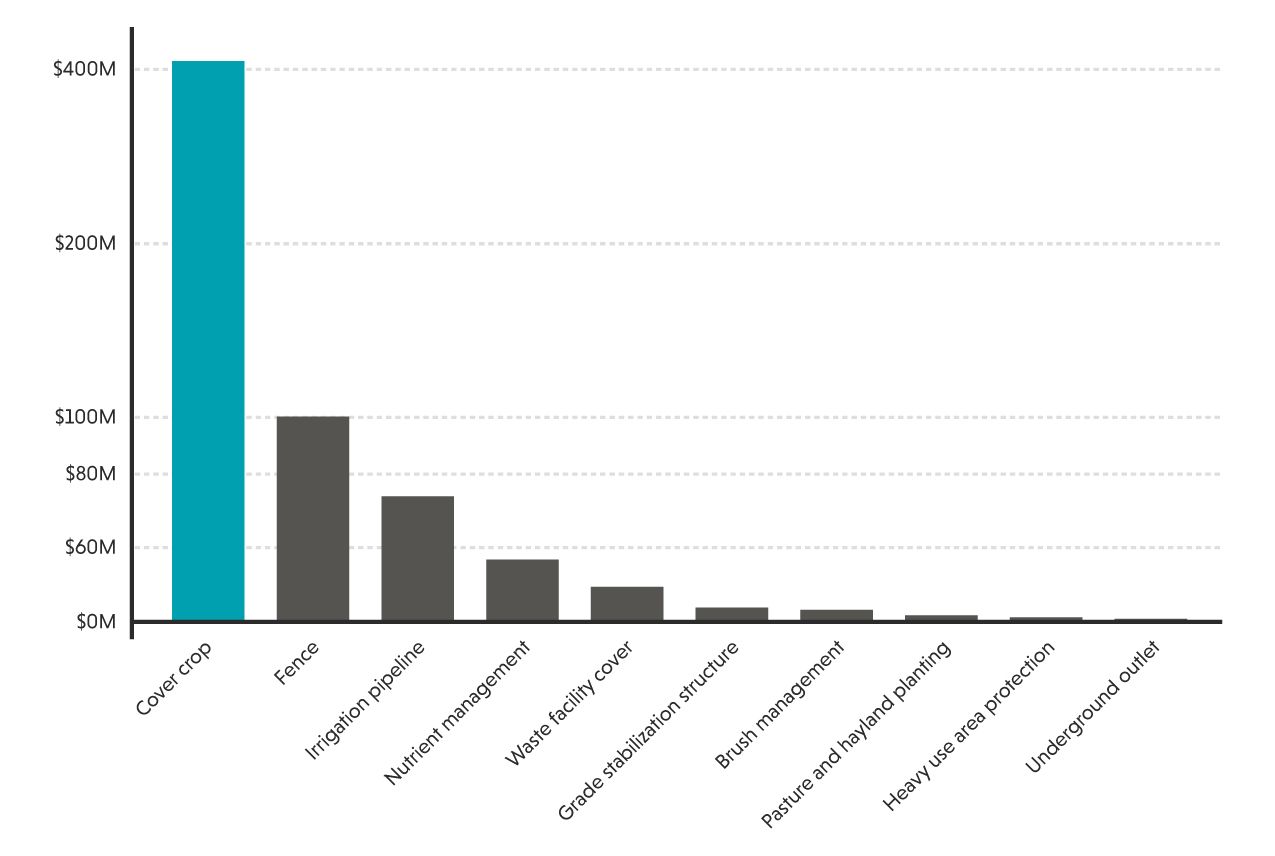
But out of the 10 EQIP practices with the most funding, only four were climate resilience practices – cover crops, nutrient management, brush management, and pasture and hayland planting. The other six were structural, building or equipment practices such as fencing and irrigation pipelines that offer little to no climate adaptation or mitigation benefits.
Structural practices are often just the cost of doing business for farms. They make up a significant share of EQIP funding. When large amounts of money go to farmers for structural practices, that money is not going to farmers to pursue climate resilience practices for adapting to extreme weather conditions.
Cover crops were by far the best-funded EQIP practice in the region, which is good, since they are included on the climate resilience practice list. But so much money is going to farmers for cover crops that other important resilience practices do not receive as much.
Farmers received almost $355.6 million more for cover crops than for the next highest-paid resilience practice, nutrient management, at only $57.2 million. (See Figure 3.)
And farmers received hardly any funding for some practices that are good for the climate and water quality, like forest farming, contour buffer strips and filter strips.
Figure 3. The 10 EQIP practices with the most payments in the MRCCA counties between 2017 and 2024.
Source: EWG, from USDA public records requests and Natural Resources Conservation Service Financial Assistance Program Data Download.
EWG’s climate resilience list includes 43 EQIP practices but just 37 received funding in the MRCCA counties between 2017 and 2024. Some of the best practices farmers can use to become more resilient to flooding and excess rain include implementing cover crops, reducing or using no tillage, diversifying crops into better flood-tolerant varieties, rotating crops, applying contour buffer strips, and converting farm fields to grazing or forest land.
Restoring wetlands in flood plains can also promote climate resiliency, and both EQIP and the USDA’s Agricultural Conservation Easement Program provide funding to farmers for wetlands restoration.
EQIP funding for climate resilience did not go to the areas of the MRCCA with the most crop and pasture acres in flood plains. Of the 20 counties with the most EQIP resilience funding, none were in the top 20 counties with the most crop and pasture land in flood plains.
Missouri, with the most flood plain crop acres, received the second-most resilience funding of the 13 MRCCA states. Farmers in Indiana had the most resilience funding while ranking only seventh on the list of states with crops in flood plains. Tennessee had the third most resilience funding but ranked ninth on the list of states with crops in flood plains.
Counties with the most floodplain crop acres are not getting enough resilience support
Farmers in counties with a lot of crop and pasture land in the 100-year flood plain received large crop insurance payments for flooding and excess moisture. For example, of the 10 counties with the most flood plain cropped acres, two were among the 10 that got the most flood crop insurance payments.
Farmers in many of the counties with the most crop and pasture acres in flood plains received significant EQIP funding, but none got much EQIP money for climate resilience practices. Four of the 20 counties with the most crop and pasture land in flood plains were also among the 20 best funded by EQIP. But none of those counties were among the 20 with the most climate resilience EQIP payments.
There is also very little overlap between the top flooding and excess rain crop insurance counties and the top EQIP climate resilience counties. None of the top 20 flood crop insurance counties were in the top EQIP climate resilience counties, and only one of the top excess precipitation crop insurance counties was also in the top 20 climate resilience counties.
More money invested in climate resilience conservation practices could reduce crop insurance payments for flooding and excess moisture in the MRCCA.
Recommendations for program reform
Crop insurance payments for flooding and excess rain are much larger than EQIP payments for climate resilience. Crop insurance pays for extreme weather damage, instead of helping farmers adapt to climate change and preventing the damage in the first place.
Crop insurance program reform can motivate farmers to become more resilient by:
- Changing the program’s subsidy structure and paperwork to encourage more farmers to use the Whole Farm Revenue Protection policy.
- Factoring recent weather events like drought, as well as projected weather, climate and crop yield data, into the premium rating process.
More funding should also be sent to farmers for EQIP practices that improve farms’ climate resilience, reduce their greenhouse gas emissions and decrease nutrient pollution to nearby waterways. Several EQIP reforms could also make it work better for farmers and improve farms’ climate resiliency. These reforms include:
- Prioritize climate resilience practices like crop diversification with a higher cost-share in EQIP, such as through Conservation Incentive Contracts, and require the USDA to consider climate mitigation and resilience potential when reviewing EQIP applications.
- Allow states to opt out of the requirement that 50% of EQIP dollars go to livestock production.
- Lower the program payment limit from $450,000 to $150,000 to prevent a few large producers from monopolizing EQIP funds.
More money for farmers through the Agricultural Conservation Easement Program, or ACEP, Wetlands Reserve Easements would also help. The ACEP Wetlands Reserve Easement option pays farmers to retire farmland into wetlands, either permanently or for many years. These easements can bring significant climate and water quality benefits when flooded crop land is retired and turned into wetlands. The IRA increased funding for ACEP by $1.4 billion. This money would help farms become more resilient.
The budget reconciliation bill recently signed into law will not make the changes that are needed to help farmers improve their climate resilience.