Jump to:

Jump to:
EWG’s recommendation
Titanium dioxide, or TiO₂, is an ingredient of concern in food, and EWG suggests limiting consumption of food containing this ingredient.
Food-grade synthetic titanium dioxide contains a substantial fraction of nanoscale particles, and although systemic absorption after ingestion is low, absorbed titanium dioxide can distribute to tissues, and studies indicate that tissue elimination may be slow.
In its 2021 assessment of TiO₂, the European Food Safety Authority, or EFSA, expressed concern about immunotoxicity and inflammation, gastrointestinal effects and neurotoxicity. The EFSA concluded that a concern for genotoxicity could not be ruled out on the basis of evidence that TiO₂ particles can induce DNA strand breaks and chromosomal damage.
Because of these findings and the remaining uncertainties, the EFSA concluded that TiO₂ could no longer be considered safe for use as a food additive (EFSA, 2021). Since TiO₂ is a food color additive, consumers can easily choose products without it.
Science analysis
What is titanium dioxide and why is it added to food?
Titanium dioxide is a synthetically produced white color additive used in some kinds of food to brighten its appearance, create a smooth finish, enhance whiteness and provide opacity for other food colors.
Where is titanium dioxide found in food?
Most commonly used in candy, titanium dioxide can also be found in salad dressing, chewing gum, ice cream, drink mixes and many other food categories.
It is used in 15,483 of the 172,081 foods added to EWG’s Food Scores between 2023 and 2025.
The 15 food categories with the most products containing titanium dioxide (by supermarket shelf)
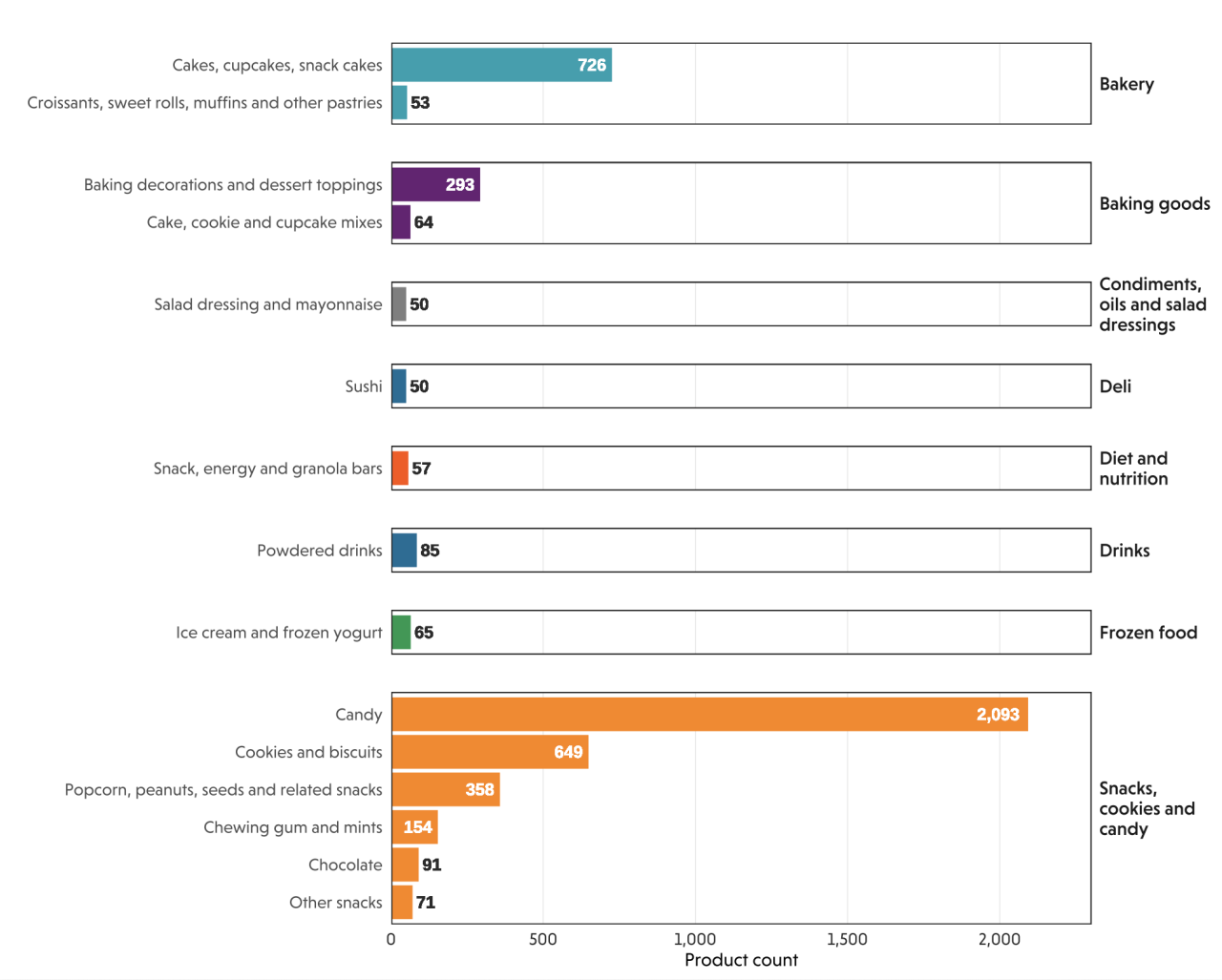
Source: EWG’s Food Scores. Label created between January 2023 and October 2025.
What is the regulatory status of titanium dioxide?
In 1973, the Food and Drug Administration authorized titanium dioxide as a food color additive in certain types of food, as long as it does not exceed 1% of the food by weight. But particle size is not limited.
Because of recent safety reviews, in 2023 EWG and other NGOs petitioned the FDA to roll back approval of titanium dioxide.
Titanium dioxide was removed from the EU’s list of approved food additives in 2022 after a 2021 EFSA re-evaluation raised concerns about its potential genotoxicity.
A 2025 Arizona ban on the use of TiO₂ in food sold in schools took effect at the beginning of the 2026-2027 school year.
Are foods containing titanium dioxide ultra-processed?
TiO₂ and other color additives are common ingredients in ultra-processed food, or UPF. As an ingredient synthesized in a laboratory, it falls into the Nova framework as a UPF ingredient. (Monteiro et al 2019).
Under a recent California law defining UPF, food containing TiO₂ qualifies as UPF because of its property as a color and coloring adjunct (Real Food, Healthy Kids Act, 2025).
Is titanium dioxide allowed in organic foods?
Under Agriculture Department organic standards, synthetic substances are prohibited in certified organic foods.
What are the potential health harms associated with titanium dioxide?
Food-grade titanium dioxide contains a nanoscale fraction, and although systemic absorption after ingestion is low, absorbed particles may persist in tissues. EFSA found that TiO₂ particles can accumulate in the body and noted that nanoscale particles showed particularly long half-lives in animal studies (EFSA, 2021).
A study using the food additive TiO₂ in mice found accumulation of TiO₂ in the intestine and liver and evidence of an inflammatory response (Talamini et al., 2019). TiO₂ particles have also been detected in human placenta and meconium, and an ex vivo study using food-grade TiO₂ nanoparticles provided evidence of maternal-fetal transfer (Guillard et al., 2020).
Experimental studies have reported the potential effects of TiO₂, particularly nanoscale forms, on the gastrointestinal, immune, neurological, reproductive and developmental systems. The EFSA identified potential immunotoxicity and inflammation, neurotoxicity, and gastrointestinal effects, including indications that TiO₂ may induce aberrant crypt foci, or ACF, in the colon, a potential marker of preneoplastic change (EFSA, 2021; Bettini et al., 2017). Studies of food-grade TiO₂ nanoparticles have also reported alterations in intestinal microbial populations, brush border membrane functionality, and intestinal morphology (Cheng et al., 2023). But these findings have not been consistently reproduced, and the EFSA found no reproductive or developmental toxicity in its TiO₂ study (EFSA, 2021).
Evidence of the genotoxicity of TiO₂ remains mixed. The EFSA concluded that TiO₂ particles have the potential to cause DNA strand breaks and chromosomal damage and that a concern for genotoxicity could not be ruled out (EFSA, 2021). A 2023 meta-analysis of 26 studies found that TiO₂ nanoparticles were associated with DNA and chromosomal damage in both in vivo and in vitro studies (Cao et al., 2023). In human intestinal cell models, exposure to digested TiO₂ nanomaterials also produced DNA damage, with some effects more pronounced after simulated digestion (Vieira et al., 2022).
In contrast, the World Health Organization’s Joint Expert Committee on Food Additives, or WHO/JECFA, concluded that the available data did not provide convincing evidence of genotoxicity, while noting limitations in current testing methods for poorly soluble particulate materials and nanoparticles (JECFA, 2023).
Uncertainties and where more research is needed
The genotoxicity of titanium dioxide remains uncertain. While the EFSA’s conclusions regarding the possible genotoxicity of TiO₂ leading to its EU ban raise concern, the WHO/JECFA could not make the same conclusions due to study limitations.
Since these assessments, studies have produced mixed findings, with some reporting DNA or chromosomal damage and others finding no evidence of genotoxicity.
Uncertainties remain regarding the mechanisms of potential genotoxic effects, the relevance of experimental findings to human exposure, and the potential genotoxic effects of nanoscale TiO₂ particles.
Human epidemiological evidence is also limited. The JECFA cautioned that available studies do not allow conclusions about associations between dietary TiO₂ exposure and human health effects.
Evidence for carcinogenicity from dietary exposure also remains uncertain. EFSA found no appropriately designed studies evaluating the carcinogenicity of TiO₂ nanoparticles. It observed that TiO₂ may induce ACF in the colon, but did not conclude TiO₂ causes cancer (EFSA, 2021).
The JECFA subsequently concluded that TiO₂ was not carcinogenic in adequately conducted two-year studies in mice and rats and also considered studies investigating the potential initiation or promotion of colon cancer (JECFA, 2023).
More details about titanium dioxide
An exposure analysis found titanium dioxide was most common in candy, chewing gum and other sweets, so children were more likely to consume more titanium dioxide than adults (Weir et al 2012).
In 2015, Dunkin’ announced it was phasing out titanium dioxide from the powdered sugar used on its doughnuts. In 2024 Mars removed titanium dioxide from Skittles sold in the U.S.
TiO₂ is also added to personal care products such as toothpaste and cosmetics and is used as an ultraviolet, or UV, filter in sunscreen products.
It is one of three active UV filters in the U.S. designed as generally recognized as safe and effective. Sunscreen products formulated with titanium dioxide have long appeared on EWG’s best lists. EWG recommends avoiding spray or powder products that contain titanium dioxide because of concerns about risks from inhaling nanoparticles and subsequent health effects.
Cited resources
Global health and regulatory agencies
- EFSA FAF Panel (EFSA Panel on Food Additives and Flavourings), 2021. Scientific Opinion on the safety assessment of titanium dioxide (E171) as a food additive. EFSA Journal 2021;19(5):6585, 130 pp. https://doi.org/10.2903/j.efsa.2021.6585
- Joint FAO/WHO Expert Committee on Food Additives (JECFA). (2023). Evaluation of certain food additives: Ninety-seventh report of the Joint FAO/WHO Expert Committee on Food Additives (WHO Technical Report Series No. 1051). World Health Organization. https://www.who.int/publications/m/item/jecfa-risk-assessment-of-titanium-dioxide-risk-released-background-information
- Food and Drug Administration. (2024). Titanium dioxide as a color additive in foods. https://www.fda.gov/industry/color-additives/titanium-dioxide-color-additive-foods
Comprehensive reviews and frameworks
- Cao, Y., Chen, J., Bian, Q., Ning, J., Yong, L., Ou, T., Song, Y., and Wei, S. (2023). Genotoxicity Evaluation of Titanium Dioxide Nanoparticles In Vivo and In Vitro: A Meta-Analysis. Toxics, 11(11), 882. https://doi.org/10.3390/toxics11110882
- Monteiro, C.A., Cannon, G., Levy, R.B., Moubarac, J., Louzada, M.L., Rauber, F., Khandpur, N., Cediel, G., Neri, D., Martinez-Steele, E., Baraldi, L.G., and Jaime, P.C. (2019). Ultra-processed foods: what they are and how to identify them. Public Health Nutrition, 22(5), 936–941. https://doi.org/10.1017/s1368980018003762
- Weir, A., Westerhoff, P., Fabricius, L., Hristovski, K., and Von Goetz, N. (2012). Titanium dioxide nanoparticles in food and personal care products. Environmental Science & Technology, 46(4), 2242–2250. https://doi.org/10.1021/es204168d
Legislation
- Arizona Healthy Schools Act, H.B. 2164, 57th Leg., 1st Reg. Sess. (2025). https://legiscan.com/AZ/text/HB2164/2025
- Real Food, Healthy Kids Act, A.B. 1264, Chapter 467, Cal. Stat. (2025). https://leginfo.legislature.ca.gov/faces/billTextClient.xhtml?bill_id=202520260AB1264.
Specific health impact studies
- Bettini, S., Boutet-Robinet, E., Cartier, C., Coméra, C., Gaultier, E., Dupuy, J., Naud, N., Taché, S., Grysan, P., Reguer, S., Thieriet, N., Réfrégiers, M., Thiaudière, D., Cravedi, J.-P., Carrière, M., Audinot, J.-N., Pierre, F.H., Guzylack-Piriou, L., and Houdeau, E. (2017). Food-grade TiO₂ impairs intestinal and systemic immune homeostasis, initiates preneoplastic lesions and promotes aberrant crypt development in the rat colon. Scientific Reports, 7, 40373. https://doi.org/10.1038/srep40373
- Cheng, J., Kolba, N., García-Rodríguez, A., Marques, C.N.H., Mahler, G. J., and Tako, E. (2023). Food-grade metal oxide nanoparticles exposure alters intestinal microbial populations, brush border membrane functionality and morphology, in vivo (Gallus gallus). Antioxidants, 12(2), 431. https://doi.org/10.3390/antiox12020431
- Guillard, A., Gaultier, E., Cartier, C., Devoille, L., Noireaux, J., Chevalier, L., Morin, M., Grandin, F., Lacroix, M. Z., Coméra, C., Cazanave, A., de Place, A., Gayrard, V., Bach, V., Chardon, K., Bekhti, N., Adel-Patient, K., Vayssière, C., Fisicaro, P., Feltin, N., de la Farge, F., Picard-Hagen, N., Lamas, B., and Houdeau, E. (2020). Basal Ti level in the human placenta and meconium and evidence of a materno-foetal transfer of food-grade TiO₂ nanoparticles in an ex vivo placental perfusion model. Particle and Fibre Toxicology, 17, 51. https://doi.org/10.1186/s12989-020-00381-z
- Talamini, L., Gimondi, S., Violatto, M.B., Fiordaliso, F., Pedica, F., Tran, N.L., Sitia, G., Aureli, F., Raggi, A., Nelissen, I., Cubadda, F., Bigini, P., and Diomede, L. (2019). Repeated administration of the food additive E171 to mice results in accumulation in intestine and liver and promotes an inflammatory status. Nanotoxicology, 13(8), 1087–1101. https://doi.org/10.1080/17435390.2019.1640910
- Vieira, A., Vital, N., Rolo, D., Roque, R., Gonçalves, L.M., Bettencourt, A., Silva, M.J., and Louro, H. (2022). Investigation of the genotoxicity of digested titanium dioxide nanomaterials in human intestinal cells. Food and Chemical Toxicology, 161, 112841. https://doi.org/10.1016/j.fct.2022.112841