Jump to:
Jump to:
EWG’s recommendation
TBHQ is an ingredient of concern, and EWG suggests limiting consumption of foods containing this ingredient.
Multiple animal studies have associated TBHQ with immune dysfunction, including evidence suggesting it may decrease the immune system’s ability to fight infections and cancer cells (Boss et al, 2018).
TBHQ has also been associated with mechanisms related to cancer development, such as the generation of reactive oxygen species and DNA damage (Ousji & Sleno, 2020). BHA, another food preservative of concern, can be metabolized to TBHQ in the body, although its contribution to overall TBHQ exposure remains unclear.
A published peer-reviewed study by EWG found TBHQ may act as an immunotoxin, affecting multiple receptors involved in regulating inflammation and immune responses. (Naidenko et al. (2021).
Science analysis
What is TBHQ and why is it added to foods?
TBHQ is a preservative that prevents oxidation, extending the shelf life of fats and oils in processed foods.
TBHQ is typically added to packaged foods like crackers, processed potato products, and baked goods that contain oil.
TBHQ is used in 2,730 of the 172,081 foods added to EWG’s Food Scores between 2023 and 2025.
Top 15 food and drink categories organized by supermarket shelf
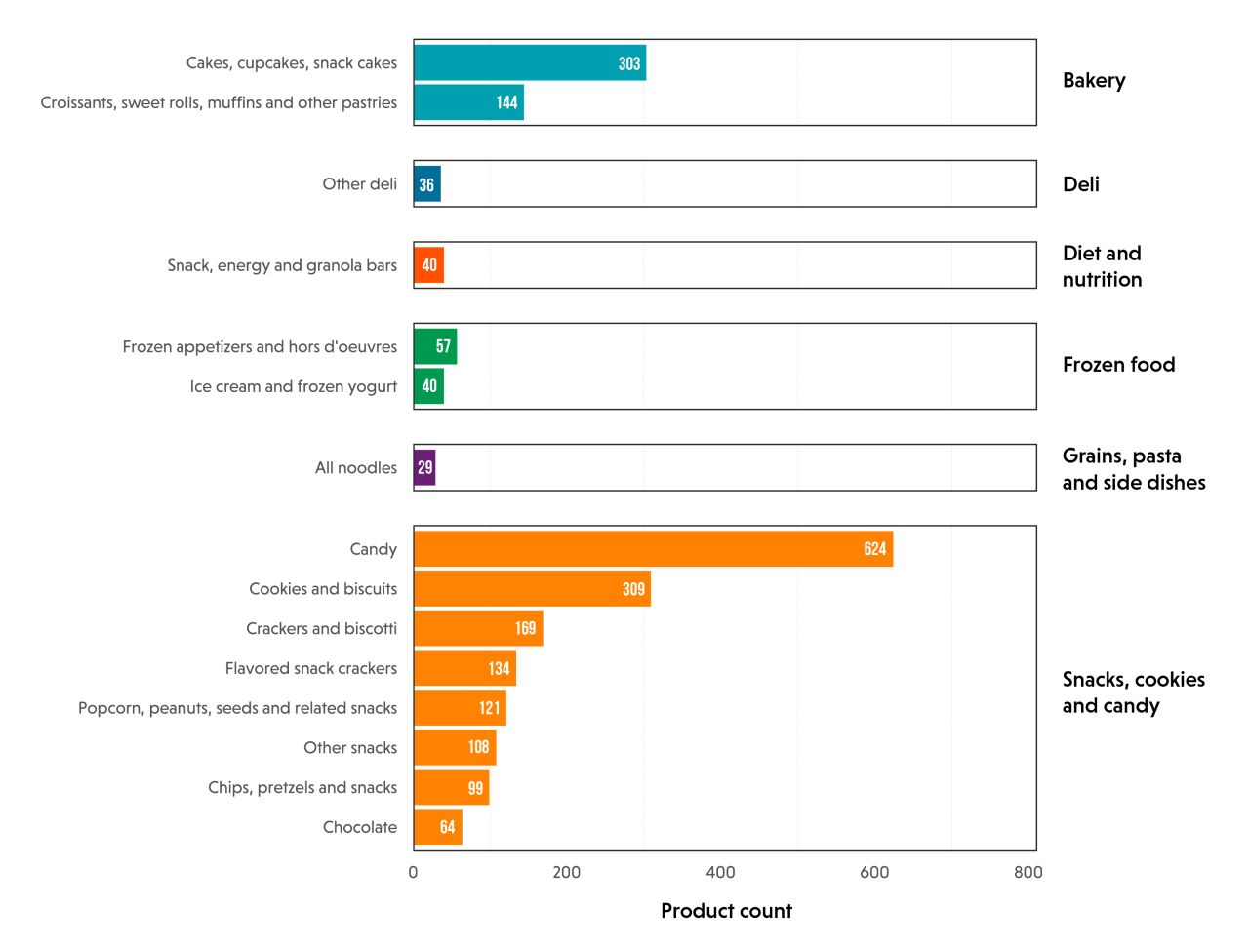
Source: EWG’s Food Scores. Label created between 2023-01-01 and 2025-10-22.
What is the regulatory status of TBHQ?
The Food and Drug Administration approved TBHQ for use in food 1972.
The European Food Safety Authority approved its use in food in 2004. The international Acceptable Daily Intake, or ADI – confirmed by the European Union and World Health Organization – is 0.7 milligrams/kilogram of body weight per day (EFSA 2016).
In 2016, based on an exposure assessment, a statement by EFSA concluded that if TBHQ were added to baby formula, it could exceed the ADI for infants and toddlers in a high consumption scenario (EFSA 2016). TBHQ is not approved for use in infant formula sold in the EU.
Are foods containing TBHQ ultra-processed?
Yes, TBHQ and other synthetic preservatives are common ingredients in ultra-processed food, or UPF. As an ingredient synthesized in a laboratory, it falls into the NOVA framework as a UPF ingredient (Monteiro et al 2019).
While most foods with TBHQ would be classified as ultra-processed, a recent California law defining UPF does not include preservatives such as TBHQ (California Assembly Bill 1264).
Is TBHQ allowed in organic foods?
No. Under Department of Agriculture organic standards, synthetic substances are prohibited in certified organic foods.
What are the potential health harms associated with TBHQ?
While TBHQ protects food from spoilage, its breakdown in the body can trigger oxidative stress. TBHQ is shown in some animal studies to cause cells to produce antioxidants, which protects them from oxidative stress by activating Nrf2, a protein. But constant activation of this protein from repeated exposure to TBHQ may do the opposite, causing immune cell dysfunction (Freeborn et al 2019).
Rodent studies have linked TBHQ to impaired immune system function and DNA damage. Doses of TBHQ that are relevant to human exposure have been shown in rodents to significantly impair NK cells, which are responsible for killing infected and cancerous cells. They may also affect the immune system's response to influenza and possibly vaccine efficacy (Freeborn et al 2019).
DNA damage was observed in rodent stomach, kidney and liver cells following higher exposure levels (Ramadan & Suzuki (2012)).
EWG published a peer-reviewed study in 2021 showing TBHQ acts as a potential immunotoxin, with activity in both high-throughput screening and classical assays. TBHQ may suppress or harm human immune responses by affecting Nrf2, the aryl hydrocarbon receptor, and the glucocorticoid receptor, which play roles in regulating inflammation and immune responses (Naidenko et al. (2021).
Uncertainties/where more research is needed
Biomonitoring studies of TBHQ and examination of exposure through consumption of foods containing BHA are needed to observe if typical intake exceeds the ADI.
BHA, another Dirty Dozen food additive, is classified as a possible human carcinogen by the International Agency for Research on Cancer, or IARC. TBHQ can form in the body when it metabolizes BHA (Ousji & Sleno (2020).
TBHQ has also been studied for therapeutic effects with respect to inhibiting neurotoxicity caused by oxidative stress (Zhao et al. (2020)).
Cited resources
Global health and regulatory agencies
- EFSA (2016). Statement on the refined exposure assessment of tertiary-butyl hydroquinone (E 319). View Statement (EFSA Journal)
- USDA National Organic Program. The National List of Allowed and Prohibited Substances. https://www.ams.usda.gov/rules-regulations/organic/national-list
- 42 Fed. Reg. 14557 (1977). https://www.govinfo.gov/content/pkg/FR-1977-03-15/pdf/FR-1977-03-15.pdf#page=421
- 37 FR Reg. 25356 (1972) https://www.federalregister.gov/citation/37-FR-25356
Comprehensive reviews and frameworks
- Monteiro et al. (2018): The UN Decade of Nutrition, the NOVA food classification and the trouble with ultra-processing. https://pubmed.ncbi.nlm.nih.gov/28322183/
Legislation
- California, Legislature, Assembly (2025). Real Food, Healthy Kids Act. California Legislative Information. https://leginfo.legislature.ca.gov/faces/billTextClient.xhtml?bill_id=202520260AB1264.
Specific health impact studies
- Naidenko et al. (2021). Investigation of Modulating Effects of Common Food Additives and Contaminants on Immune Cell Functions.https://www.mdpi.com/1660-4601/18/7/3590
- Freeborn et al. (2019). Tert-Butylhydroquinone (tBHQ) Impairs the Immune Response to Influenza Virus Infection. https://faseb.onlinelibrary.wiley.com/doi/abs/10.1096/fasebj.2019.33.1_supplement.505.3
- Eskandani et al. (2014). Cytotoxicity and DNA damage properties of tert-butylhydroquinone (TBHQ) food additive.https://pubmed.ncbi.nlm.nih.gov/24491735/
- Ousji & Sleno (2020). Identification of In Vitro Metabolites of Synthetic Phenolic Antioxidants BHT, BHA, and TBHQ.https://pmc.ncbi.nlm.nih.gov/articles/PMC7765162/
- Boss et al. (2018). The Nrf2 activator tBHQ inhibits the activation of primary murine natural killer cells. https://www.sciencedirect.com/science/article/abs/pii/S0278691518306240?via%3Dihub
- Zhao et al. (2020). t-BHQ Provides Protection against Lead Neurotoxicity via Nrf2/HO-1 Pathway. https://pmc.ncbi.nlm.nih.gov/articles/PMC4698940/