Jump to:
Jump to:
EWG’s recommendation
Sucralose is an ingredient of concern. EWG suggests avoiding or limiting consumption of products with this ingredient or using sucralose as a sugar substitute. This recommendation is specific to frequent consumption and non-medical uses.
The World Health Organization in 2023 completed a systematic review of 283 studies on the consumption of non-sugar sweeteners and found they provided no long-term weight loss benefit. The review also identified potential harm, including increased risk of Type 2 diabetes, cardiovascular disease and mortality in adults, as well as preterm birth (WHO 2023).
There is potential for widespread, repeated exposure, since sucralose is a common sugar substitute, especially in beverages and foods, which are consumed regularly. They are often marketed as “low calorie” or “zero sugar.” (Sylvetsky and Rother 2016, Sylvetsky et al 2012, Grilo et al 2023).
Science analysis
What is sucralose and why is it added to foods?
Sucralose, a tabletop sweetener sold under the brand name Splenda, is a non-nutritive, or artificial, sweetener that is about 600 times sweeter than sugar. It tastes similar to sugar but has zero calories.
Where is sucralose found in foods?
Sucralose is typically added to sugar-free or “low calorie” diet foods and drinks.
Sucralose is present in 5,574, or 3.2%, of the 172,081 foods added to EWG’s Food Scores between 2023 and 2025.
Top 15 food and drink categories, organized by supermarket shelf
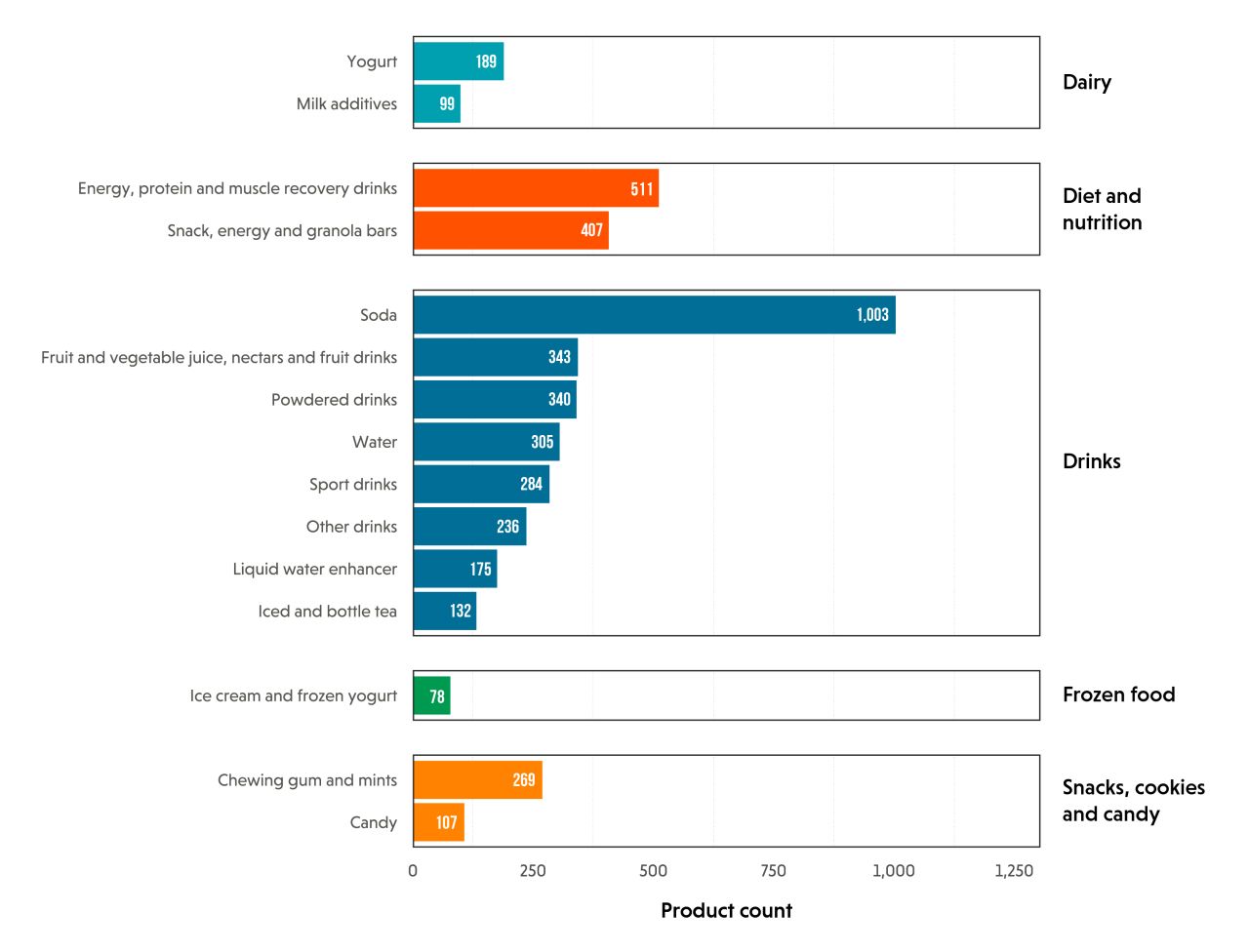
Source: EWG’s Food Scores. Label created between January 1, 2023, and October 22, 2025.
What is the regulatory status of sucralose?
Sucralose is approved for use in foods and beverages in both the U.S. and Europe. The Food and Drug Administration in 1998 established an acceptable daily intake, or ADI, of 5 mg/kg body weight per day.
In California, a law was passed with implementation starting in 2029 that targets ultraprocessed food, or UPF, of concern in school meals, and any food with an artificial sweetener is considered a UPF.
In Europe, the European Food Safety Authority and the joint FAO/WHO Expert Committee on Food Additives have set an ADI of 15 mg/kg body weight per day.
In the EU, sucralose is not permitted in food or supplements for infants or young children, with exceptions for food for special medical purposes. In 2026, the EU classified sucralose as a low-concern ingredient but did raise concern about uses where the ingredient was heated, such as in baked goods or fried foods.
Are foods containing sucralose ultra-processed?
Non-sugar sweeteners are not only commonly used in UPF, they are identified in the NOVA framework as characteristic markers of UPF (Monteiro et al 2019). California’s recent law defining UPF includes any food with “a nonnutritive sweetener” (California Assembly Bill 1264).
Is sucralose allowed in organic foods?
No. Under Department of Agriculture organic standards, synthetic substances such as artificial sweeteners are prohibited in certified organic foods.
What are the potential health harms associated with sucralose?
The WHO completed a systematic review in 2023 finding consumption of non-sugar sweeteners provided no long-term weight benefit but did lead to potential harm, including increased risk for Type 2 diabetes, cardiovascular disease and mortality in adults as well as preterm birth (WHO 2023).
EFSA published a re-evaluation of sucralose’s safety in 2026. It said that based on the available evidence, current intake levels were of low concern, except when heated. These heated foods may be a source of chlorinated compounds (EFSA 2026).
Recent rodent studies have linked sucralose to disruption of the gut microbiome, weight gain, cardiometabolic disease, and persistence in body fat and breast milk (Zheng et al 2021, Ragi et al 2021, Risdon et al 2021, Bornemann et al 2018, Sylvetsky et al 2015).
Evidence also suggests that, because of how it’s broken down in the body, sucralose when ingested can affect satiety – the feeling of fullness – which in turn can lead to overeating (Wang et al. 2016).
Uncertainties/where more research is needed
Health effects of long-term regular consumption of sucralose – people who consume sucralose exclusively for long periods of time – focused on pregnant people, children and those with metabolic diseases (Debras et al. 2022, WHO 2023).
Health risks from exposure to chlorinated compounds formed from baked/fried goods containing sucralose (EFSA 2026).
Health effects of transfer of sucralose to young children through pregnant or breastfeeding parents (Sylvetsky et al. 2017).
Cited resources
Global health and regulatory agencies
- World Health Organization (WHO). (2023). Use of non-sugar sweeteners: WHO guideline. https://www.who.int/publications/i/item/9789240073616
- U.S. Food and Drug Administration (FDA). (1999). Food Additives Permitted for Direct Addition to Food for Human Consumption; Sucralose. https://www.govinfo.gov/content/pkg/FR-1999-08-12/pdf/99-20888.pdf
- European Parliament and Council. (2008). Regulation (EC) No 1333/2008 on food additives. https://eur-lex.europa.eu/eli/reg/2008/1333/oj/eng
- USDA National Organic Program. The National List of Allowed and Prohibited Substances. https://www.ams.usda.gov/rules-regulations/organic/national-list
- European Food Safety Authority (EFSA). (2026). Re-evaluation of sucralose (E 955) as a food additive. https://www.efsa.europa.eu/en/topics/topic/sweeteners (Current portal)
Legislation
- California, Legislature, Assembly (2025). Real Food, Healthy Kids Act. California Legislative Information. https://leginfo.legislature.ca.gov/faces/billTextClient.xhtml?bill_id=202520260AB1264.
Comprehensive reviews and frameworks
- Aguayo-Guerrero, J., et al. (2024). Sucralose: From Sweet Success to Metabolic Controversies—Unraveling the Global Health Implications of a Pervasive Non-Caloric Artificial Sweetener. https://pmc.ncbi.nlm.nih.gov/articles/PMC10971371/
- Monteiro, C. A., et al. (2019). Ultra-processed foods, diet quality, and health using the NOVA classification system. https://openknowledge.fao.org/server/api/core/bitstreams/5277b379-0acb-4d97-a6a3-602774104629/content
- Risdon, S., et al. (2021). Non-nutritive Sweeteners and Cardiometabolic Health: A Review. https://pubmed.ncbi.nlm.nih.gov/33578411/
Consumption trends and exposure
- Sylvetsky, A. C., & Rother, K. I. (2016). Trends in the consumption of low-calorie sweeteners. https://pubmed.ncbi.nlm.nih.gov/27039282/
- Sylvetsky, A. C., et al. (2012). Consumption of Low-Calorie Sweeteners among Children and Adults in the United States. https://pubmed.ncbi.nlm.nih.gov/28087414/
- Grilo, M. F., et al. (2023). Global intake of non-sugar sweeteners: A systematic review. https://www.cambridge.org/core/journals/british-journal-of-nutrition/article/consumption-of-lowcalorie-sweeteners-findings-from-the-campinas-nutrition-and-health-survey/6F97B9417AAE5195F8271BAEEFB9EEAC
Specific health-impact studies
- Singh, A. S., et al. (2024). Unveiling the profound influence of sucralose on metabolism and its role in shaping obesity trends. https://pmc.ncbi.nlm.nih.gov/articles/PMC11250074/
- Wang, Y., et al. (2016). Sucralose Promotes Food Intake through NPY and a Neuronal Fasting Response https://pubmed.ncbi.nlm.nih.gov/38217520/
- Zheng, Z., et al. (2022). Impact of sucralose on the gut microbiome. https://pubmed.ncbi.nlm.nih.gov/35284433/
- Sylvetsky, A. C., et al. (2015). Non-nutritive Sweeteners in Breast Milk.https://pubmed.ncbi.nlm.nih.gov/26267522/
- Sylvetsky, A. C., et al. (2017). Plasma concentrations of sucralose in children and adults. https://pubmed.ncbi.nlm.nih.gov/28775393/
- Debras, C., et al. (2022). Artificial sweeteners and cancer risk: Results from the NutriNet-Santé cohort. https://pubmed.ncbi.nlm.nih.gov/35324894/
- Bornemann, V., et al. (2018). Intestinal Metabolism and Bioaccumulation of Sucralose In Adipose Tissue In The Rat. https://www.tandfonline.com/doi/full/10.1080/15287394.2018.1502560
- Ragi, S., et al. (2021). The effect of aspartame and sucralose intake on body weight measures and blood metabolites: role of their form (solid and/or liquid) of ingestion. https://www.cambridge.org/core/journals/british-journal-of-nutrition/article/effect-of-aspartame-and-sucralose-intake-on-body-weight-measures-and-blood-metabolites-role-of-their-form-solid-andor-liquid-of-ingestion/F97EA712AAC19B3D5A8E98BCE78AD22E