Jump to:

Jump to:
EWG’s recommendation
BHA is an ingredient of concern. EWG suggests limiting consumption of foods with this ingredient.
The National Toxicology Program in 1991 classified BHA as “reasonably anticipated to be a human carcinogen.” It has been listed as a known carcinogen under California’s Proposition 65 since 1990.
BHA is also shown to produce oxidative stress, which can disrupt cellular function and damage DNA and cells (Esazadeh et al. 2024; Ousji & Sleno, 2020; Sasaki et al 2002). These mechanisms are associated with cancer development.
Multiple animal studies have identified BHA as an endocrine-disrupting chemical, affecting reproductive health through estrogenic and androgenic activity (Pop et al 2018; Ham et al 2020).
Science analysis
What is BHA and why is it added to foods?
BHA, or butylated hydroxyanisole, is a preservative that prevents oxidation, extending the shelf life of fats and oils in processed foods.
BHA is typically added to packaged and frozen foods like frozen pizza, meats, biscuits and other processed goods that contain oil.
BHA is used in 1,726 of the 172,081 foods added to EWG’s Food Scores between 2023 and 2025.
Top 15 food categories with the most products containing BHA (by supermarket shelf)
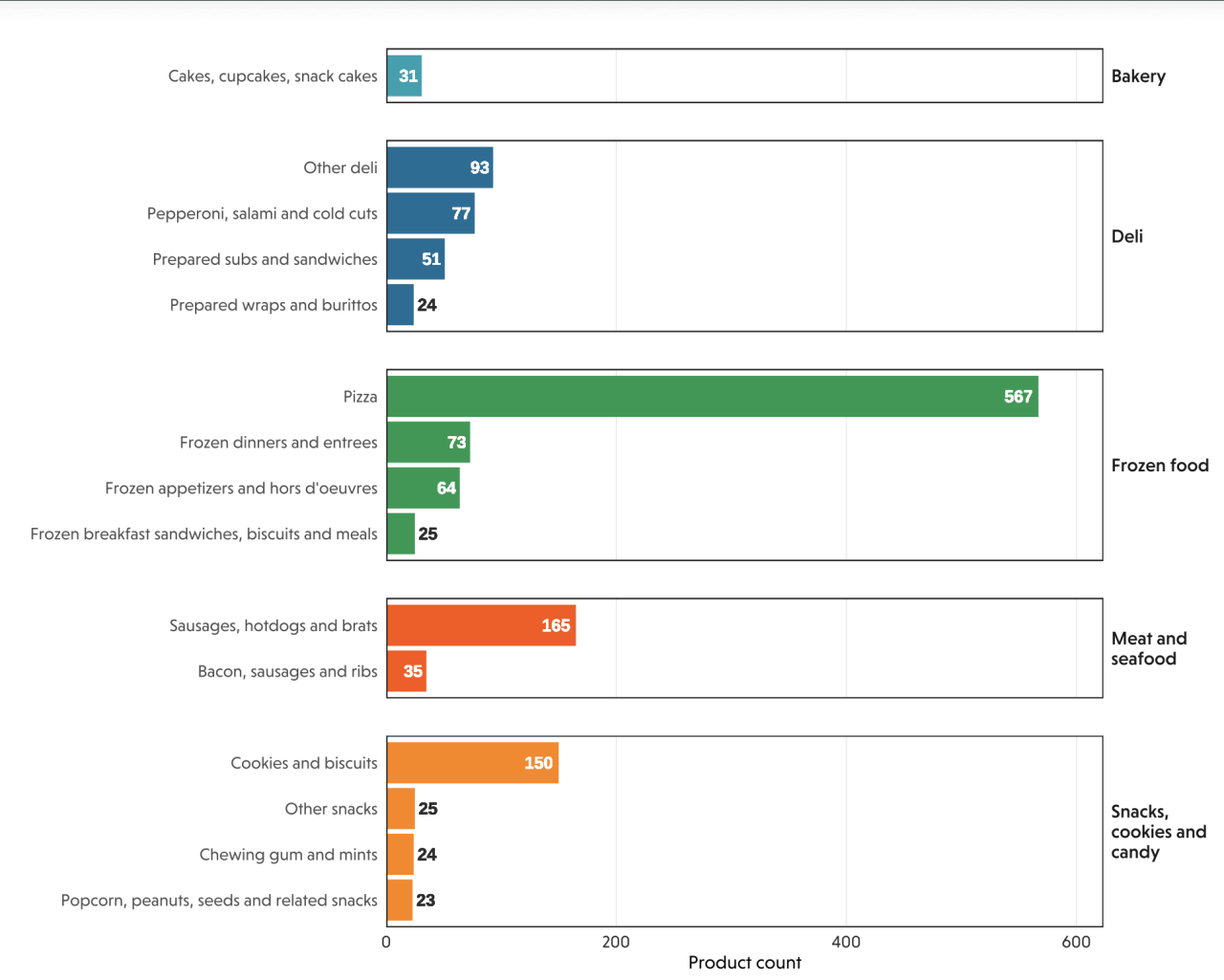
Source: EWG’s Food Scores. Label created between 2023-01-01 and 2025-10-22
What is the regulatory status of BHA?
The Food and Drug Administration classified BHA as GRAS in 1958 and approved it for use in food in 1961.
It is commonly added to food as an antioxidant, with the limitation that the total antioxidant content not exceed 0.02% of the total fat or oil content of the food.
In early 2026, the FDA identified BHA as a top priority for review of chemicals currently in the food supply and issued a request for information on its use and safety. EWG has also issued a statement and comment letter in response to this request.
BHA was first evaluated for use in food in the European Union in 1989, following the international safety benchmark established that same year by the Joint FAO/WHO Expert Committee on Food Additives. Both that committee and the EU Scientific Committee for Food set an acceptable daily intake (ADI) of 0.5 mg/kg body/day.
In 2011, the European Food Safety Authority (EFSA) re-evaluated BHA and established an ADI of 1.0 mg/kg bw/day. This change occurred because the safety authority concluded that the forestomach tumors observed in rodent studies were not relevant to human risk assessment, since humans do not possess a forestomach.
However, EFSA noted data gaps, including questions about BHA’s potential for endocrine effects.
Recent research shows that BHA’s risks extend beyond the forestomach. Studies have shown DNA damage in human-relevant organs like the glandular stomach and significant endocrine-disrupting effects on reproductive health (Sasaki et al., 2002; Pop et al., 2018).
BHA is classified by the International Agency for Research on Cancer as a Group 2B carcinogen, and the National Toxicology Program concluded it was “reasonably anticipated to be a human carcinogen.”
BHA is also on the state of California’s Proposition 65 list of substances known to cause cancer.
In 2025, West Virginia banned BHA from all food sold in the state beginning in 2028.
Are foods containing BHA ultra-processed?
BHA and other synthetic preservatives are common ingredients in ultra-processed food, or UPF. As an ingredient synthesized in a laboratory, it falls into the NOVA framework as a UPF ingredient. (Monteiro et al 2019).
Under a recent California law defining UPF, BHA would qualify as a UPF based on its property as a flavor enhancer. (California Assembly Bill 1264).
Is BHA allowed in organic foods?
Under Department of Agriculture organic standards, synthetic substances like BHA are prohibited in certified organic foods.
What are the potential health harms associated with BHA?
As an antioxidant, BHA protects food from spoilage. But its breakdown in the body into metabolites can trigger production of reactive oxygen species, which causes oxidative stress and subsequent cell damage. Oxidative stress is associated with cancer and numerous other diseases.
Research also stresses the potential of BHA to cause genotoxicity at high concentrations, resulting in structural damage to DNA and cellular proteins (Xu et al 2021; Zhang et al 2023).
DNA damage was observed in vivo within animal tissues, the colon and glandular stomach, which are shared by humans, whereas the forestomach (the site of BHA-induced tumors in earlier rodent studies) is not (Sasaki et al 2002).
Furthermore, a study in breast cancer cells has linked BHA to endocrine disruption, exhibiting both estrogenic and androgenic activities (Pop et al 2018). Prolonged exposure to BHA in one rodent study reduced testicular function in mice (Ham et al 2020).
There is potential for BHA to work additively with other food chemicals of concern, like propyl gallate, to induce anti‐estrogenic activity (Pop et al 2018).
Uncertainties and need for more research
BHA can metabolize into TBHQ, another EWG Dirty Dozen food additive (Ousji & Sleno, 2020).
Biomonitoring studies of TBHQ and examination of exposure through consumption of foods containing BHA are needed to see whether typical intake is higher than the acceptable daily intake.
BHA has been detected in human breast milk (Zhang et al 2020), the placenta (Du et al 2019), and adipose tissue (Conacher et al 1986), indicating a need for improved safety assessments of BHA.
Older studies observed the development of cancer cells in the forestomachs of rats exposed to BHA (Ito et al 1983; Ito et al 1986; Hirose et al 1987). But research on humans has been limited. (Zhang et al 2023; Botterweck 2000; Hasenböhler 2026).
More studies are needed on the cumulative effects of BHA and similar antioxidant preservatives, such as BHT and TBHQ (Hasenböhler 2026).
BHA is also used as a preservative in cosmetic products. The ingredient scores a 7 in EWG’s Skin Deep® database and is not allowed in EWG Verified® products.
Cited resources
Global health and regulatory agencies
- Office of the Commissioner. (2026, February 10). FDA launches assessment of BHA, a common food chemical preservative. U.S. Food And Drug Administration. FDA Launches Assessment of BHA, a Common Food Chemical Preservative.
- The National List | Agricultural Marketing Service. (n.d.). The National List | Agricultural Marketing Service.
- National Toxicology Program, Department of Health and Human Services. (2011). Report on Carcinogens, Fifteenth Edition. In National Toxicology Program, Department of Health and Human Services [Report]. Report on Carcinogens, Fifteenth Edition - Butylated Hydroxyanisole.
- Joint FAO/WHO Expert Committee on Food Additives. (1989). Evaluation of certain food additives and contaminants: thirty-third report of the Joint FAO/WHO Expert Committee on Food Additives. WHO Technical Report Series, (776), 1-64. https://iris.who.int/server/api/core/bitstreams/c4ccf354-a21d-428e-87fe-4b0fa9f810df/content.
- EFSA Panel on Food Additives and Nutrient Sources added to Food (ANS). (2011). Scientific Opinion on the re-evaluation of butylated hydroxyanisole (BHA) (E 320) as a food additive. EFSA Journal, 9(10), 2392 https://doi.org/10.2903/j.efsa.2011.2392.
Legislation
- 21 CFR 182.3169 – Butylated hydroxyanisole. (n.d.). https://www.ecfr.gov/current/title-21/chapter-I/subchapter-B/part-182/subpart-D/section-182.3169.
- Real Food, Healthy Kids Act, A.B. 1264, Chapter 467, Cal. Stat. (2025). https://leginfo.legislature.ca.gov/faces/billTextClient.xhtml?bill_id=202520260AB1264.
- Banning certain products from food in West Virginia, House Bill 2354, (2025). https://legiscan.com/WV/text/HB2354/id/3177443.
Comprehensive review and frameworks
- Monteiro, C.A., Cannon, G., Levy, R.B., Moubarac, J., Louzada, M.L., Rauber, F., Khandpur, N., Cediel, G., Neri, D., Martinez-Steele, E., Baraldi, L.G., & Jaime, P.C. (2019). Ultra-processed foods: what they are and how to identify them. Public Health Nutrition, 22(5), 936–941. https://doi.org/10.1017/s1368980018003762.
- Xu, X., Liu, A., Hu, S., Ares, I., Martínez-Larrañaga, M., Wang, X., Martínez, M., Anadón, A., & Martínez, M. (2021). Synthetic phenolic antioxidants: Metabolism, hazards and mechanism of action. Food Chemistry, 353, 129488. Synthetic phenolic antioxidants: Metabolism, hazards and mechanism of action - ScienceDirect.
- Zhang, X., Diao, M., & Zhang, Y. (2023b). A review of the occurrence, metabolites and health risks of butylated hydroxyanisole (BHA). Journal of the Science of Food and Agriculture, 103(13), 6150–6166. https://doi.org/10.1002/jsfa.12676
- Pop, A., Kiss, B., & Loghin, F. (2013). Endocrine disrupting effects of butylated hydroxyanisole (BHA - E320). Clujul Medical, 86(1), 16–20. https://pubmed.ncbi.nlm.nih.gov/26527908/.
- Esazadeh, K., Dolatabadi, J. E. N., Andishmand, H., Mohammadzadeh‐Aghdash, H., Mahmoudpour, M., Kermanshahi, M. N., & Roosta, Y. (2024). Cytotoxic and genotoxic effects of tert‐butylhydroquinone, butylated hydroxyanisole and propyl gallate as synthetic food antioxidants. Food Science & Nutrition, 12(10), 7004–7016. https://doi.org/10.1002/fsn3.4373.
- Ousji, O., & Sleno, L. (2020). Identification of in vitro metabolites of synthetic phenolic antioxidants BHT, BHA, and TBHQ by LC-HRMS/MS. International Journal of Molecular Sciences, 21(24), 9525. https://doi.org/10.3390/ijms21249525.
Health-impact studies
- Ham, J., Lim, W., You, S., & Song, G. (2019). Butylated hydroxyanisole induces testicular dysfunction in mouse testis cells by dysregulating calcium homeostasis and stimulating endoplasmic reticulum stress. The Science of the Total Environment, 702, 134775. https://doi.org/10.1016/j.scitotenv.2019.134775.
- Pop, A., Drugan, T., Gutleb, A. C., Lupu, D., Cherfan, J., Loghin, F., & Kiss, B. (2018). Estrogenic and anti‐estrogenic activity of butylparaben, butylated hydroxyanisole, butylated hydroxytoluene and propyl gallate and their binary mixtures on two estrogen responsive cell lines (T47D‐Kbluc, MCF‐7). Journal of Applied Toxicology, 38(7), 944–957. https://doi.org/10.1002/jat.3601.
- Sasaki, Y. F., Kawaguchi, S., Kamaya, A., Ohshita, M., Kabasawa, K., Iwama, K., Taniguchi, K., & Tsuda, S. (2002). The comet assay with 8 mouse organs: results with 39 currently used food additives. Mutation Research/Genetic Toxicology and Environmental Mutagenesis, 519(1-2), 103-119.
- Ito, N., Fukushima, S., Hagiwara, A., Shibata, M., & Ogiso, T. (1983). Carcinogenicity of butylated hydroxyanisole in F344 rats. Journal of the National Cancer Institute, 70(2), 343-352.
- Ito, N., Fukushima, S., Tamano, S., Hirose, M., & Hagiwara, A. (1986). Dose response in butylated hydroxyanisole induction of forestomach carcinogenesis in F344 rats. Journal of the National Cancer Institute, 77(6), 1261–1265.
- Hirose, M., Masuda, A., Tsuda, H., Uwagawa, S., & Ito, N. (1987). Enhancement of BHA-induced proliferative rat forestomach lesion development by simultaneous treatment with other antioxidants. Carcinogenesis, 8(11), 1731–1735. https://doi.org/10.1093/carcin/8.11.1731.
- Botterweck, A. A. M., Verhagen, H., Goldbohm, R. A., Kleinjans, J., & van den Brandt, P. A. (2000). Intake of butylated hydroxyanisole and butylated hydroxytoluene and stomach cancer risk: results from analyses in the Netherlands Cohort Study. Food and Chemical Toxicology, 38(7), 599-605. https://doi.org/10.1016/s0278-6915(00)00042-9.
- Hasenböhler, A., Javaux, G., Payen de la Garanderie, M., Szabo de Edelenyi, F., Yvroud-Hoyos, P., Agaësse, C., De Sa, A., Huybrechts, I., Pierre, F., Audebert, M., Coumoul, X., Julia, C., Kesse-Guyot, E., Allès, B., Deschamps, V., Hercberg, S., Chassaing, B., Srour, B., Deschasaux-Tanguy, M., & Touvier, M. (2026). Intake of food additive preservatives and incidence of cancer: results from the NutriNet-Santé prospective cohort. The BMJ, 392, bmj-2025-084917. https://doi.org/10.1136/bmj-2025-084917.
Biomonitoring Studies
- Zhang, Y., Du, B., Ge, J., Liu, L., Zhu, M., Li, J., & Zeng, L. (2020). Co-occurrence of and infant exposure to multiple common and unusual phenolic antioxidants in human breast milk. Environmental Science & Technology Letters, 7(3), 206–212. https://doi.org/10.1021/acs.estlett.0c00104
- Conacher, H. B., Iverson, F., Lau, P. Y., & Page, B. D. (1986). Levels of BHA and BHT in human and animal adipose tissue: interspecies extrapolation. Food and chemical toxicology : an international journal published for the British Industrial Biological Research Association, 24(10-11), 1159–1162. https://doi.org/10.1016/0278-6915(86)90302-9
- Du, B., Zhang, Y., Lam, J. C. W., Pan, S., Huang, Y., Chen, B., Lan, S., Li, J., Luo, D., & Zeng, L. (2019). Prevalence, Biotransformation, and Maternal Transfer of Synthetic Phenolic Antioxidants in Pregnant Women from South China. Environmental science & technology, 53(23), 13959–13969. https://doi.org/10.1021/acs.est.9b04709