Two additives, known as ADA and BHT, are found in cereal, baked goods and other processed food millions of Americans enjoy. They’re also linked to potential health harms such as cancer and hormone disruption, so EWG is reiterating calls for banning their use in food.
Even though research on the two chemicals is ongoing, studies so far in animals or humans have already found their potential to cause health problems. These concerns justify the Food and Drug Administration revoking its approval for use of the two additives, EWG said in a pair of letters submitted to the agency earlier this month.
Safer alternatives to ADA and BHT are available, allowing manufacturers to achieve the same functions without relying on these chemicals. Some retailers – including major chains like Pizza Hut and Whole Foods Market – have already taken steps to get one or both of the additives out of their products.
It’s time for the regulatory system to catch up with the science and food companies’ voluntary actions.
Ongoing FDA review
The comments follow the FDA’ s request for information, or RFI, about the two chemicals in food earlier this year – ADA, or azodicarbonamide, and BHT, or butylated hydroxytoluene.
It’s part of the agency’s new program to reevaluate the safety of food chemicals.
The RFI only gathers input – it isn’t any kind of policy action. But the comments it receives on the request could eventually be used to guide decisions about allowing the additives in food.
That’s why EWG weighed in with written comments highlighting our concerns. The deadline to submit comments on BHT has been extended to August 13. The comment period for ADA closed on July 13.
What is ADA?
ADA was greenlighted for use in food in 1962 by the FDA as “generally recognized as safe,” or GRAS. It’s added to baked goods as a dough conditioner.
ADA breaks down during breadmaking, and two of its breakdown products, semicarbazide and urethane, have been shown to cause cancer. Urethane can also damage the reproductive system.
Because of these concerns, ADA is not permitted as a food additive in Australia or the European Union. International evaluations have also identified kidney effects in laboratory animals exposed to ADA.
Despite these concerns, the FDA has not thoroughly reexamined ADA’s safety in light of newer research on its potential health effects.
Lawmakers in New York and Texas introduced legislation to remove ADA from food sold in their states, but neither bill passed.
Several food retailers, including Whole Foods, Aldi and Walmart, have voluntarily removed or restricted ADA in their products. A 2025 survey by the American Bakers Association found that nearly 95% of its member companies already don’t use ADA.
Given the evidence of health risks – and how few companies still use the chemical – the FDA should take decisive action to end the use of ADA in food.
What is BHT?
The FDA approved BHT for use in food in 1954 and deemed it GRAS in 1959. The chemical is commonly added to breakfast cereal, frozen pizza, chewing gum and other processed foods, acting as a preservative, extending the shelf life of fats and oils.
While it has not been formally classified as a carcinogen, studies have linked it to tumor promotion in animals. It has also been linked to damage to DNA and hormonal disruption.
A 2019 study found that U.S. residents had some of the highest exposure levels of BHT globally, with some exposure estimates exceeding safety limits. The chemical has been detected in human cord blood, breast milk, blood, urine and body fat.
Some states have already acted on concerns about BHT’s health effects, and several major food retailers and manufacturers, including Whole Foods and General Mills, have voluntarily removed the chemical from many products.
Given the already available evidence showing the potential health risks of BHT, the FDA should act to immediately revoke approval for its use in food.
The trouble with GRAS
Both BHT and ADA remain on the market, thanks to their GRAS status.
When Congress created the GRAS exemption, in 1958, it was intended to apply to ingredients whose safety was beyond dispute, such as salt, water, yeast and vinegar.
But in the decades since, GRAS has expanded far beyond that intent. Since 2000, nearly 99% of new food chemicals have entered the market through the GRAS loophole, according to a 2025 EWG analysis. This lets scores of food chemicals reach store shelves with little government oversight, leaving food safety in the hands of manufacturers.
To protect the safety of our food supply from harmful chemicals like BHT and ADA, the FDA must close the GRAS loophole.
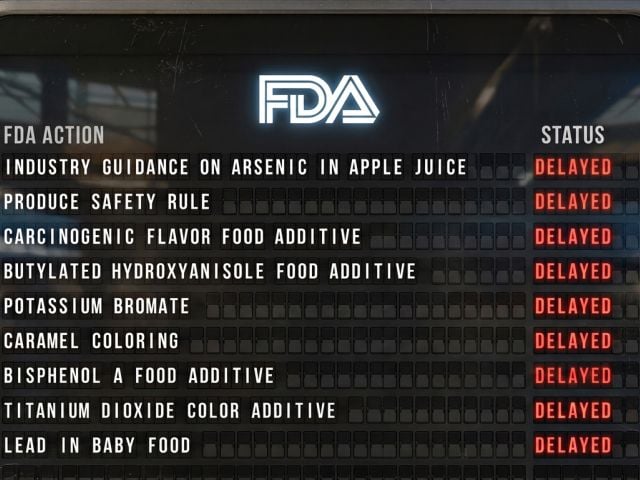
In March 2025 the Department of Health and Human Services, of which the FDA is part, announced a plan to review GRAS, originally slated for October 2025. That timeline has since been delayed to December 2026. The announcement could eventually lead to changes in the GRAS rule, but without firm proposals, there’s no real progress on food safety.
In the absence of enforceable federal action on GRAS, New York passed a bill that would ban use of three harmful food chemicals statewide – Red Dye No. 3, potassium bromate and propyl paraben – and reform the GRAS loophole at the state level. The bill awaits Gov. Kathy Hochul’s signature.
What you can do
While we wait for the FDA to act on BHT and ADA and amend the GRAS loophole, consumers can minimize exposure to harmful food chemicals with these tips.
- Check ingredient labels and avoid food products that contain BHT and ADA. Food companies must list these on packaged food labels if they’re added as a food ingredient.
- Consult EWG’s Food Scores database to find products without BHT, ADA and other concerning ingredients. When you’re on the go, use EWG’s Healthy Living™ app to find products without toxic chemicals.
- Whenever possible, look for packaged foods that are certified organic. These products must meet strong standards that protect consumers from exposure to potentially harmful additives.
- Reduce consumption of ultra-processed foods when possible. Many contain ingredients of concern that could harm your health.