More than 92,000 “city slickers” living in some of the biggest metropolitan areas in the U.S. took in over $2.6 billion in farm subsidies between 2020 and 2025, even though many of these people don’t live or work on farms, a new EWG analysis finds.
The soaring payouts went to 13,000 more city slickers compared to last year’s analysis, that looked at payments through 2024, EWG found. At the same time, farm bankruptcies have recently reached new heights.
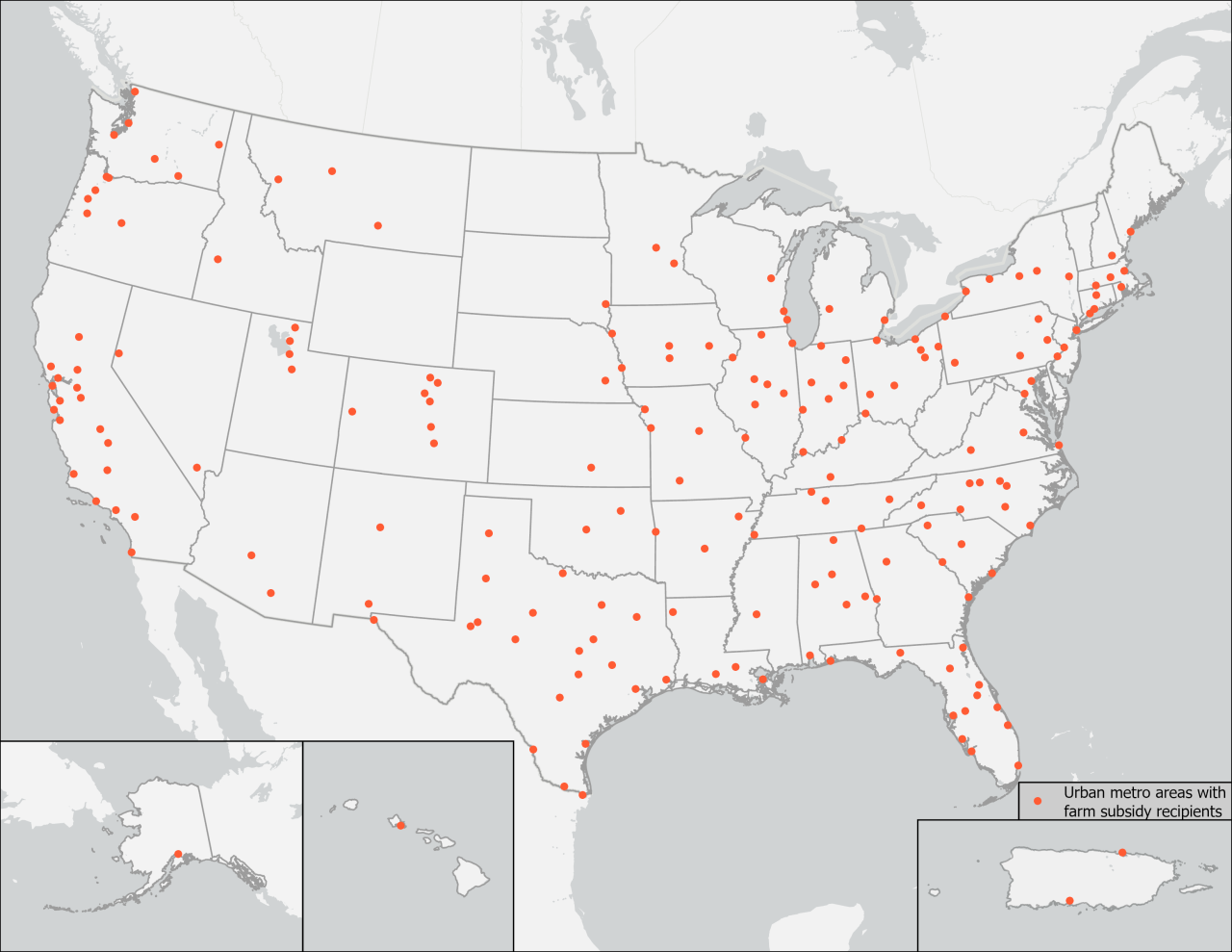
EWG analyzed Department of Agriculture data and found that between 2020 and 2025, $2.6 billion in farm subsidies went to 92,766 residents of Chicago, Los Angeles, Miami, New York and 197 other major metro areas – with many never setting foot on farmland.
These payments averaged more than $28,000 per person between 2020 and 2025, or just over $4,700 each per year, EWG’s analysis found.
Even more taxpayer funds are going to city recipients this year after Republicans in Congress pushed through President Donald Trump’s One Big Beautiful Bill Act. The law enlarged loopholes that make it easier to qualify for the payouts and get more money.
It hiked payment limits from $125,000 to $155,000 per person, letting every member of some farms collect up to $155,000 a year each, even if they don’t live or work on a farm, as long as it is organized as a pass-through entity, such as a joint venture, S corporation or limited liability corporation.
EWG compiled a list of the 200 biggest metro areas, along with the number of urban recipients and the total farm subsidies they received between 2020 and 2025, including many new recipients in those areas possibly benefiting from the expanded loopholes:
200 largest metro areas with city slicker subsidy recipients
Record subsidy amounts
The U.S. is reaching record levels of agricultural industry bailouts, exceeding $25 billion since early 2025, with even more taxpayer-funded handouts still being requested. And these latest bailouts follow payouts from multiple disaster programs in the first and second Trump administrations.
The subsidy increases were paid for with cuts to Medicaid totaling nearly $1 trillion and $187 billion in cuts to hunger assistance programs. These reductions have led to hospital closings and the loss of hunger assistance for over 4 million Americans, including more than 800,000 children.
As more and more funding is made available for farm subsidies, many recipients benefit from rules that allow people not involved in day-to-day life on the farm to collect payments.
Farm subsidy recipients must be “actively engaged” in farming.
But it’s very easy to qualify as “actively engaged,” even for someone who never lives or works on a farm. The farm bill’s loopholes allow urban residents to get farm subsidies, even if they do not live or work on a farm. The Government Accountability Office in 2018 found that roughly one-fourth of farm subsidy recipients do not contribute any personal labor to farms.
Another GAO report, issued last month, examined improper payments made to the agriculture industry. It found that a tariff relief program from Trump’s first term had an improper payment rate of 19.3%. A USDA disaster program made improper payments at a rate of 45.2%.
The White House recently requested $11 billion to once again bail out the agricultural industry over the rising costs of fertilizer and fuel from Trump’s war with Iran. This would drive up total farm safety net spending to over $55 billion in 2026 alone.
The proposed “Farm Bill 2.0” making its way through the Senate this month will do nothing to fix these problems. Instead it will maintain the status quo and send billions of dollars in subsidies to city slickers who have nothing to do with farming.
Locating city slickers
For the analysis, EWG identified city slickers living in ZIP codes in the 200 most populous metro areas. Using existing datasets, EWG identified city slicker subsidy recipients as those living in areas with a population density greater than 3,000 people per square mile within census-designated metro areas.
To rule out non-urban areas, the methodology looked at places the USDA doesn’t consider rural as well as ZIP codes that are outside a distance to a city center dictated by the city’s population size. The methodology also looked at other metrics to determine an area's rural status.
This analysis updates and builds on previous EWG estimates of city slickers, which included only recipients who lived within city limits. The updated methodology seeks to capture urban sprawl, which has changed how certain areas are defined, and to foster a better understanding of how many subsidy recipients live in urban areas.