The Trump administration is asking Congress to send another $11 billion to farmers through taxpayer-funded farm subsidies, even though many would-be recipients are wealthy farms that already receive billions through several farm subsidy programs.
If Congress approves the request, it would be on top of the $12 billion currently allotted to farmers through the Farmer Bridge Assistance Program this year.
Farmers also already receive payments from two other categories: commodity programs and the federal Crop Insurance Program, new EWG research finds. According to data in EWG’s recently updated Farm Subsidy Database, farmers last year received a staggering $29.5 billion by “triple dipping” into three categories of farm subsidies.
The administration’s request, combined with these other payouts, would make payments swell to over $50 billion in 2026. This will place an even greater burden on taxpayers whose median income and wealth remain well below those of the average farm household. Total payments would make up a third of farm income this year.
Many smaller farmers are facing legitimate financial challenges, including lower commodity prices, higher input costs and uncertainty driven by President Donald Trump’s tariffs and the war with Iran. But America’s farm subsidy system overwhelmingly rewards the nation’s largest and wealthiest operations, not the family farms most in need of assistance.
Trump’s latest $11 billion bailout plan is largely the result of self-inflicted problems: a farm economy troubled due to the tariffs and war, which he started and which created instability in the global export markets. Rather than addressing those underlying policy choices, the administration is once again asking taxpayers to foot the bill.
Neither the House farm bill passed this spring nor the Senate farm bill now under consideration would make any much-needed changes to federal farm subsidy programs. Reform is vital to limit – not increase – the many billions taxpayers are paying to lucrative farms every year. These farms already benefit from multiple programs – they don’t need more support.
Triple dipping happens each year
EWG identified three sources of the billions in Department of Agriculture 2025 payments: crop insurance and traditional commodity farm subsidy programs that pay out every year, and ad hoc programs approved by Congress.
Six individual programs are covered by the three USDA farm support payment categories:
- An indemnity payment from the taxpayer-subsidized federal Crop Insurance Program.
- A payment from one of two traditional commodity subsidy programs tied to crop prices or revenues: the Price Loss Coverage program, or PLC, and the Agricultural Risk Coverage program, or ARC.
- Payments from three ad hoc programs established by Congress: the Emergency Commodity Assistance Program to help farmers with increased costs and reduced crop prices, and the Supplemental Disaster Relief Program and the Emergency Livestock Relief Program designed to support farmers through weather and climate disasters.
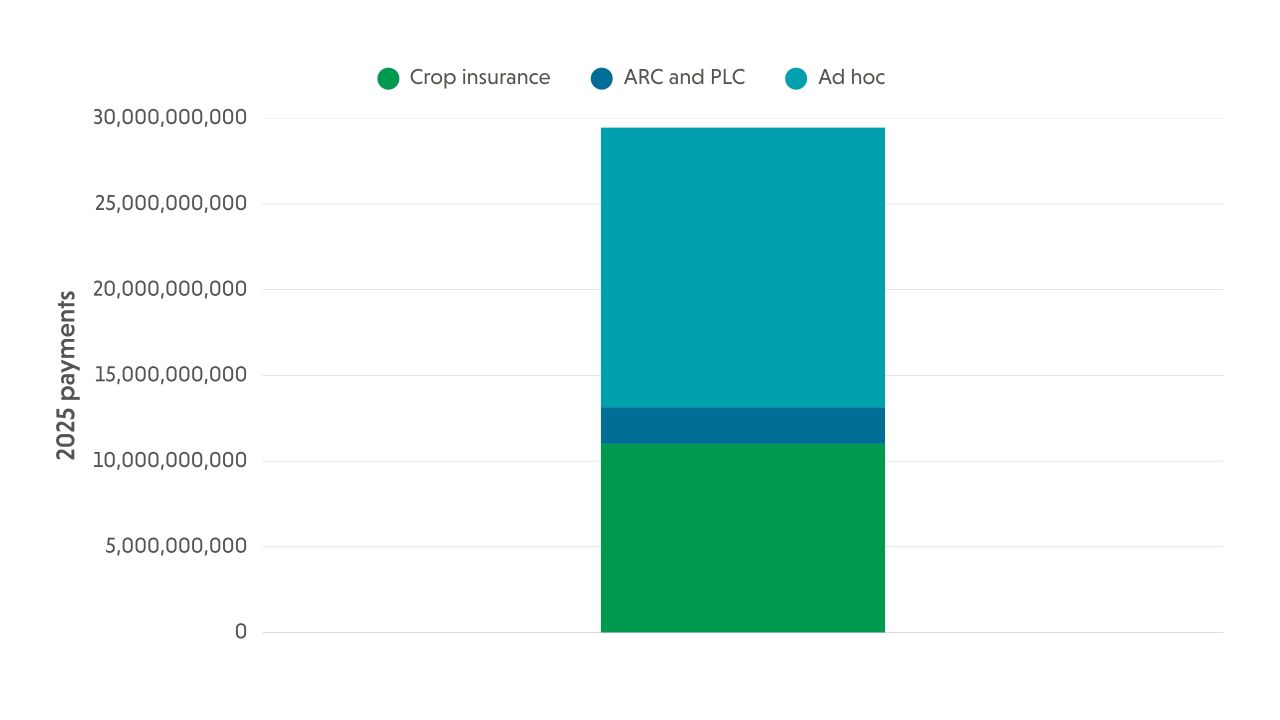
Farmers collected $29.5 billion in 2025 from the three types of payments. The largest share of payments were made in the ad hoc category. Together the three ad hoc programs accounted for $16.3 billion, representing over half of all payments. (See Figure 1.)
Crop insurance paid out 37% of total payments from all programs in 2025, or $11 billion. Payments from the ARC and PLC commodity programs made up the smallest share, at $2.1 billion, or 7% of total payments.
But ARC and PLC payments will increase from 2025 levels in future years due to higher subsidies established in Trump’s One Big Beautiful Bill Act, or OBBBA, which Republicans pushed through Congress last year.
Figure 1. Ad hoc farm subsidy programs were by far the largest source of payments to farmers in 2025
Source: EWG, from the USDA Risk Management Agency, Summary of Business data, and Farm Service Agency, Payment Files Information
Farmers in 3,053 counties across the country received payments from at least one of the three farm support categories. In a total of 2,320 counties, or 76%, farmers collected payments from all three.
The ad hoc programs had the largest reach, with farmers in 98% of the counties receiving payments.
Just under half of all payments from the three payment categories – $14 billion in taxpayer dollars – went to farmers in just seven states, in descending order of largest payments: Texas, Minnesota, Kansas, Iowa, Nebraska, North Dakota and Illinois.
The payments were very highly concentrated in just a few states, with farmers in Texas, Minnesota and Kansas alone accounting for 25% of all payments.
Farmers and taxpayers pay into crop insurance premiums every year. Taxpayers shoulder 63% of the cost, on average, and indemnity payments are made from total premiums collected.
Taxpayers foot all – 100% – of the cost of traditional commodity farm subsidy programs and the ad hoc subsidy programs. An increase in ad hoc subsidies, as the administration is requesting, would send considerably more taxpayer money to farmers.
The largest farms benefit the most
The push for another bailout comes as some farmers are struggling financially given increased costs for critical supplies like such as fuel and fertilizer,
And it’s a jarring request at a time when millions of hardworking Americans across the country are also grappling with everyday living costs. Incomes are not keeping up with the rising cost of living, and almost half of Americans cannot afford basic living expenses like food, rent and healthcare.
Trump’s bid to send even more taxpayer money from an additional ad hoc program to farmers would benefit the largest and wealthiest farms the most.
In 2025, the top 10% of farms received 59% of all commodity subsidies. At the same time, the smallest 80% of recipients only got 22% of payments.
Most farm subsidies go to growers of commodity crops like corn and soybeans. Very little funding goes to farms that grow food like the fruits and vegetables millions of Americans eat, referred to as “specialty crops.”
Farm household income and wealth are also significantly higher than the average U.S. household. In 2024, the median farm household income was $102,748, much greater than the median U.S. household income of $83,730.
Just 2% of all family farm households had levels of wealth below the median American wealth.
Farmers qualify for commodity and ad hoc subsidies as long as their annual income is not above $900,000 per person, or $1.8 million for a farmer and his or her spouse. But the Crop Insurance Program does not have an income limit, so farmers who make above that level still qualify for premium subsidies and indemnity payments.
No need for more payments
The Trump administration’s latest proposal comes a year after enactment of the OBBBA, which expanded farm subsidies while paying for those increases by making deep cuts to nutrition assistance for hungry Americans.
By expanding subsidies at the expense of hungry people, the law increases the likelihood of farmers’ triple dipping into multiple farm support programs. It causes serious harm to millions while benefiting relatively few farmers.
Reform of the farm subsidy program to prevent triple dipping and make other much-needed fixes to these massive payouts is long overdue. But the House-passed farm bill and Senate farm bill under consideration won’t rein in farm subsidies.
Mostly large and wealthy commodity crop growers already receive billions of dollars from multiple farm subsidy programs every year. These farmers do not need even more taxpayer support from another new Trump-driven ad hoc farm subsidy program.