Jump to:

Jump to:
EWG’s recommendation
BHT is an ingredient of concern, and EWG suggests limiting consumption of foods containing this ingredient.
BHT is shown in multiple studies to cause damage to cells through production of metabolites and oxidative stress (Xu et al., 2021). These are mechanisms associated with a number of diseases including cancer. BHT is not a listed carcinogen, but some data have shown that it does cause cancer in animals. In high dose studies in animals it has been linked to hepatic toxicity, and the promotion of tumors in the liver, bladder, and lungs (Liu & Mabury, 2020; Xu et al., 2021). BHT has been shown to cause developmental effects and thyroid changes in animals, suggesting that it may be able to disrupt endocrine signaling (European Food Safety Authority,2012).
In certain high exposure scenarios, EFSA noted that children's dietary intake of BHT could exceed its acceptable daily intake, or ADI.
Science analysis
What is BHT and why is it added to foods?
BHT is a preservative that prevents oxidation, extending the shelf life of fats and oils in processed foods.
BHT is typically added to breakfast cereal, frozen pizza and chewing gum.
BHT is used in 2,974 of the 172,081 foods added to EWG’s Food Scores between 2023 and 2025.
Top 15 food and drink categories with products containing BHT, organized by supermarket shelf
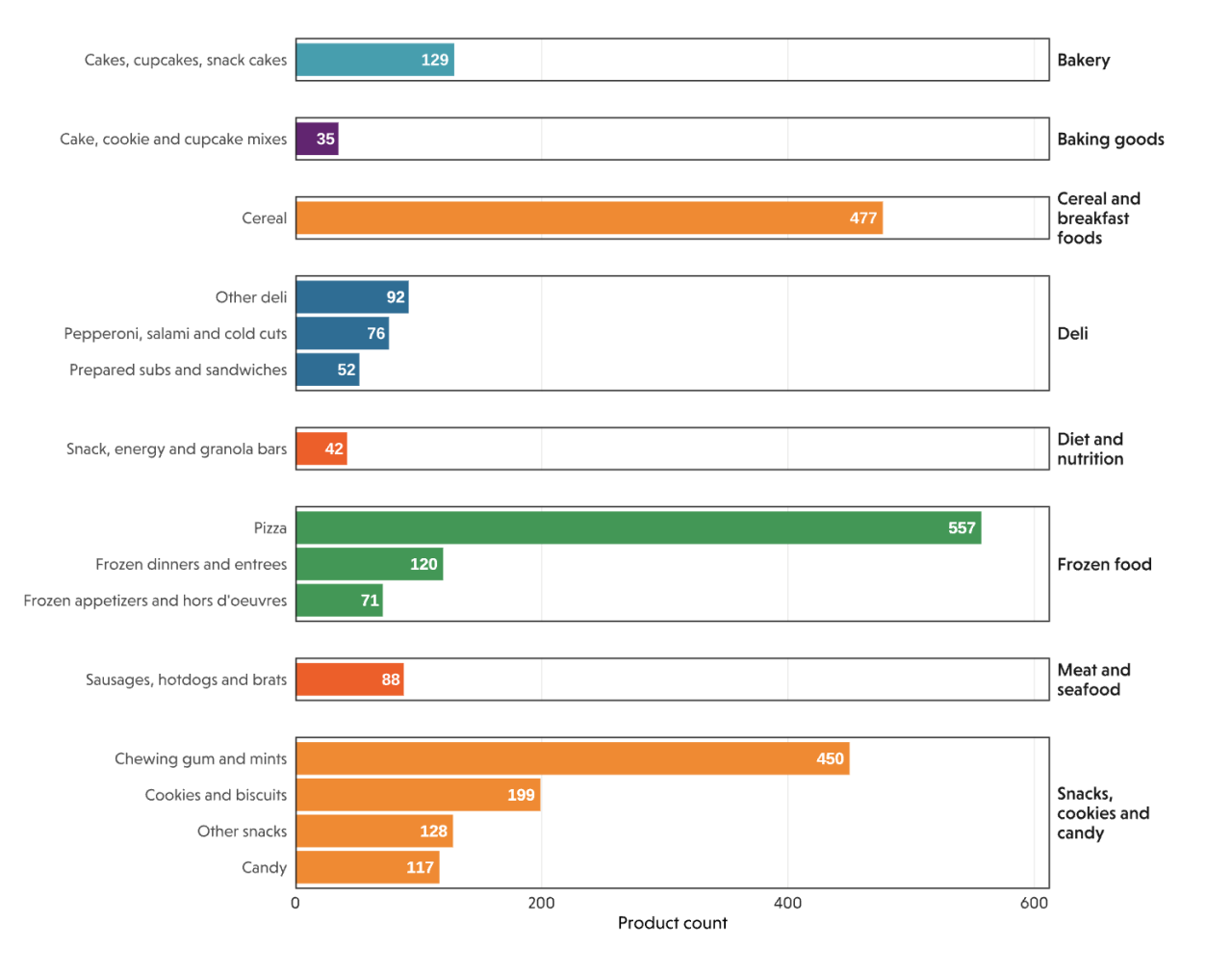
Source: EWG’s Food Scores. Label created between January 1, 2023 and October 10, 2023.
What is the regulatory status of BHT?
The Food and Drug Administration approved BHT for use in food in 1954 and it was deemed “generally recognized as safe,” or GRAS, in 1959 for certain uses.
An ADI of 0.3 mg/kg was set for BHT by WHO in 1996. The European Union’s Scientific Committee on Food originally set the ADI to 0.05 mg/kg in 1987, based on reproduction, thyroid and hematological effects observed in rodent studies. The EFSA reevaluated BHT in 2012 and found the chemical to be of less concern, raising the ADI to 0.25 mg/kg.
Also, if BHT as a food contact material is added to food additive intake estimates, children would ingest more than the ADI at both the mean and high-consumption levels. The EFSA concluded that typical dietary exposures were within the ADI.
As of February 2026, the FDA plans to reassess the safety of BHT in food.
Are foods containing BHT ultra-processed?
Yes, BHT and other synthetic preservatives are common ingredients in ultra-processed food, or UPF. As an ingredient synthesized in a laboratory, it falls into the NOVA framework as a UPF ingredient. (Monteiro et al., 2019).
Under a recent California law defining UPF, BHT would qualify as a UPF ingredient based on its property as a flavor enhancer and flavoring agent/adjuvant. (California Assembly Bill 1264).
Is BHT allowed in organic foods?
No. Under Department of Agriculture organic standards, synthetic substances are prohibited in certified organic foods.
What are the potential health harms associated with BHT?
The breakdown of BHT in the body into metabolites produces reactive intermediates that may pose risks to human health. While the cytotoxicity of BHT has long been recognized, recent studies published after its major regulatory evaluations have further clarified the precise mechanisms behind this cellular damage.
The tumor-promoting effects of BHT are mainly influenced by production of quinone methylation metabolites such as BHT-QM (Xu et al., 2021). Its metabolites are electrophilic, which means they bind well to cellular proteins and DNA (Lanigan and Yamarik, 2002).
Like BHA, its metabolite production causes oxidative stress, DNA damage and cell death (Castro et al., 2017). While BHT is not considered a carcinogen by IARC, its mechanisms are related to carcinogenesis.
High-dose animal studies have linked BHT exposure to hepatic toxicity, endocrine disruption and the promotion of tumors in the liver, bladder, and lungs (Liu & Mabury 2020; Xu et al., 2021). Oral studies in rats showed renal and hepatic damage at acute doses of 0.5 to 1.0 g/kg (Lanigan and Yamarik 2002). Subacute exposure at lower doses was linked to liver toxicity in rats (Moon et al., 1987).
BHT has been found in human cord blood (Du et al., 2019), breast milk (Zhang et al., 2020), serum (Liu & Mabury 2018), urine (Liu & Mabury 2018) and adipose tissue (Collings & Sharratt, 1970).
An exposure study conducted in 2019 found that U.S. residents had some of the highest levels of BHT, compared to other countries, with the highest exposures exceeding the ADI (Wang & Kannan, 2019).
Uncertainties and the need for more research
There are data gaps for multiple routes of BHT exposure and how well it is absorbed, as well as health effects of co-exposure with other synthetic phenolic antioxidants (Liu & Mabury, 2020).
BHT is also added as an antioxidant in consumer products such as polyurethane, which is used in mattresses, plastics, carpets and printing inks. From these products, it can migrate into the air and settle in house dust.
Although food is the most significant source of BHT exposure, dust has been reported to be an important source indoors (Liu & Mabury 2020), especially in children, who ingest more dust, on average (Wang et al 2015).
BHT is also added to cosmetic products as a preservative. As of publication, the ingredient scores a 5 in EWG’s Skin Deep® database and is not allowed in EWG Verified® products.
Cited resources
Global health and regulatory agencies
- Abstract for TR-150. (June, 17, 2025). National Toxicology Program. https://ntp.niehs.nih.gov/publications/reports/tr/tr150
- WHO, JECFA (n.d.) https://apps.who.int/food-additives-contaminants-jecfa-database/Home/Chemical/2142
- EFSA Panel on Food Additives and Nutrient Sources added to Food (ANS). (2014). Scientific opinion on the re‐evaluation of propyl gallate (E 310) as a food additive. EFSA Journal, 12(4), Article 3642. https://doi.org/10.2903/j.efsa.2014.3642
- Office of the Commissioner. (February 10, 2026). FDA launches assessment of BHA, a common food chemical preservative. U.S. Food And Drug Administration. https://www.fda.gov/news-events/press-announcements/fda-launches-assessment-bha-common-food-chemical-preservative
Comprehensive reviews and frameworks
- Xu, X., Liu, A., Hu, S., Ares, I., Martínez-Larrañaga, M.-R., Wang, X., Martínez, M., Anadón, A., & Martínez, M.-A. (2021). Synthetic phenolic antioxidants: Metabolism, hazards and mechanism of action. Food Chemistry, 353, Article 129488. https://doi.org/10.1016/j.foodchem.2021.129488
- Lanigan, R.S., & Yamarik, T.A. (2002). Final report on the safety assessment of BHT(1). International journal of toxicology, 21 Suppl 2, 19–94. https://doi.org/10.1080/10915810290096513
- Monteiro, C.A., Cannon, G., Levy, R.B., Moubarac, J., Louzada, M.L., Rauber, F., Khandpur, N., Cediel, G., Neri, D., Martinez-Steele, E., Baraldi, L.G., & Jaime, P.C. (2019). Ultra-processed foods: what they are and how to identify them. Public Health Nutrition, 22(5), 936–941. https://doi.org/10.1017/s1368980018003762
- Castro LdS, Bracht L, Comar J.F., Peralta R.M., Bracht A.A. reappraisal of the proposed metabolic and antioxidant actions of butylated hydroxytoluene (BHT) in the liver. J Biochem Mol Toxicol. 2017;31:e21924. https://doi.org/10.1002/jbt.21924
- Liu, R., & Mabury, S.A. (2020). Synthetic Phenolic Antioxidants: A review of environmental occurrence, fate, human exposure, and toxicity. Environmental Science & Technology, 54(19), 11706–11719. https://doi.org/10.1021/acs.est.0c05077
Legislation
- Real Food, Healthy Kids Act, A.B. 1264, Chapter 467, Cal. Stat. (2025).https://leginfo.legislature.ca.gov/faces/billTextClient.xhtml?bill_id=202520260AB1264
Specific health impact and biomonitoring studies
- Moon, C., Lee, S., Park, K., Hwang, G., Mock, M., Chung, D., Kim, D., & Min, S. (1987). In vivo immunotoxicities of butylated hydroxyanisole (BHA) and butylated hydroxytoluene (BHT) in male mice. Archives of Pharmacal Research, 10(4), 223–227. https://doi.org/10.1007/bf02857744
- Du, B., Zhang, Y., Lam, J.C.W., Pan, S., Huang, Y., Chen, B., Lan, S., Li, J., Luo, D., & Zeng, L. (2019). Prevalence, Biotransformation, and Maternal Transfer of Synthetic Phenolic Antioxidants in Pregnant Women from South China. Environmental science & technology, 53(23), 13959–13969. https://doi.org/10.1021/acs.est.9b04709
- Zhang, Y., Du, B., Ge, J., Liu, L., Zhu, M., Li, J., & Zeng, L. (2020). Co-occurrence of and infant exposure to multiple common and unusual phenolic antioxidants in human breast milk. Environmental Science & Technology Letters, 7(3), 206–212. https://doi.org/10.1021/acs.estlett.0c00104
- Liu, R., & Mabury, S.A. (2018). Unexpectedly High Concentrations of a Newly Identified Organophosphate Ester, Tris(2,4-di-tert-butylphenyl) Phosphate, in Indoor Dust from Canada. Environmental Science & Technology, 52(17), 9677–9683. https://doi.org/10.1021/acs.est.8b03061
- Collings, A.J.; Sharratt, M. The BHT content of human adipose tissue. Food Cosmet. Toxicol. 1970, 8(4), 409−412.
- Wang, W., & Kannan, K. (2019). Quantitative identification of and exposure to synthetic phenolic antioxidants, including butylated hydroxytoluene, in urine. Environment International, 128, 287-295. https://doi.org/10.1016/j.envint.2019.04.028
- Soubra L., Sarkis D., Hilan C., Verger P. (2007). Dietary exposure of children and teenagers to benzoates, sulphites, butylhydroxyanisol (BHA) and butylhydroxytoluen (BHT) in Beirut (Lebanon). Regul Toxicol Pharmacol. 47(1):68-77. https://doi:10.1016/j.yrtph.2006.07.005.
- Wang, W., Asimakopoulos, A. G., Abualnaja, K. O., Covaci, A., Gevao, B., Johnson-Restrepo, B., Kumosani, T. A., Malarvannan, G., Minh, T. B., Moon, H., Nakata, H., Sinha, R. K., & Kannan, K. (2015). Synthetic Phenolic Antioxidants and Their Metabolites in Indoor Dust from Homes and Microenvironments. Environmental Science & Technology, 50(1), 428–434. https://doi.org/10.1021/acs.est.5b04826