Overview
- EWG found 15,309 Iowa factory farms producing over 107 million tons of manure a year.
- The number of large animal facilities increased by 13% between 2019 and 2025.
- The state’s livestock produce significant amounts of manure that pollute drinking water and recreational water, leading to public health harms like cancer.
- Because of inadequate oversight, polluted drinking water results from all sizes of facilities.
Iowa – the nation’s top hog producer – had more than 15,000 factory farms in 2025 producing over 107 million tons of manure, a first-of-its-kind EWG analysis finds. This waste can pollute water, exposing people to serious health risks like cancer.
EWG mapped every livestock facility across Iowa to uncover the massive scale of the farms and their manure. The waste generated would weigh the same as over 53 million Ford F150 pickup trucks, and would account for 33 tons of manure each year for every person in Iowa.
And the problem isn’t limited to Iowa.
A third of all pork raised in the U.S. is produced in Iowa, which is by far the largest hog-producing state. Minnesota, the runner-up, makes up only 12% of total U.S. hog production. If you’ve eaten pork, it’s very likely that you've eaten pork from hogs raised in Iowa. The consequences of huge Iowa hog farms extend far beyond the state borders.
The Iowa Department of Natural Resources tracks the number of hog and other animal feeding operations and their locations, with a data file showing just under 11,000 facilities.
In contrast, EWG’s well-established methodology located thousands more facilities that are not included in the state’s dataset. This analysis found more than 15,000 factory farms on the ground from aerial and satellite imagery, providing the most comprehensive picture yet of Iowa’s enormous industrial livestock footprint.
This investigation updates a 2020 EWG analysis that mapped the state’s largest animal operations only. That study found there were 3,936 large factory farms in the state in 2019. Our latest research found a 12.9% increase in large facilities, to 4,444 in 2025.
The vast amounts of manure these facilities generate are often applied to nearby farm fields as a fertilizer, since it contains nitrogen and phosphorus, nutrients that feed crops. But manure and its components can wash off farm fields, leach through soil into drainage systems that empty into nearby rivers, streams and lakes, and get into groundwater.
Nitrogen can form in drinking water as nitrate, and consuming this contaminated water can increase the risk of birth defects and cancer. Iowa is the state with the second-highest rate of new cancer cases.
Manure runoff can also create potentially toxic algae blooms in recreational waters when more nutrients are applied than crops can absorb. EWG has reported on algae toxins in bodies of water throughout Iowa.
To help reduce the environmental and public health damages caused by livestock raised in these facilities, consumers can choose to eat less meat or eat meat not raised in a factory farm. And federal and state-level policies must change to improve public health and the safety of water for Iowans.
Iowa produces huge amounts of manure
Animal feeding operations are concentrated facilities and feedlots that produce livestock for meat, eggs and dairy products. Hundreds and even thousands of cattle, swine, chickens, turkeys and other animals are raised in large buildings or, in the case of cattle, in open feedlots. Over 90% of U.S. livestock are raised in factory farms.
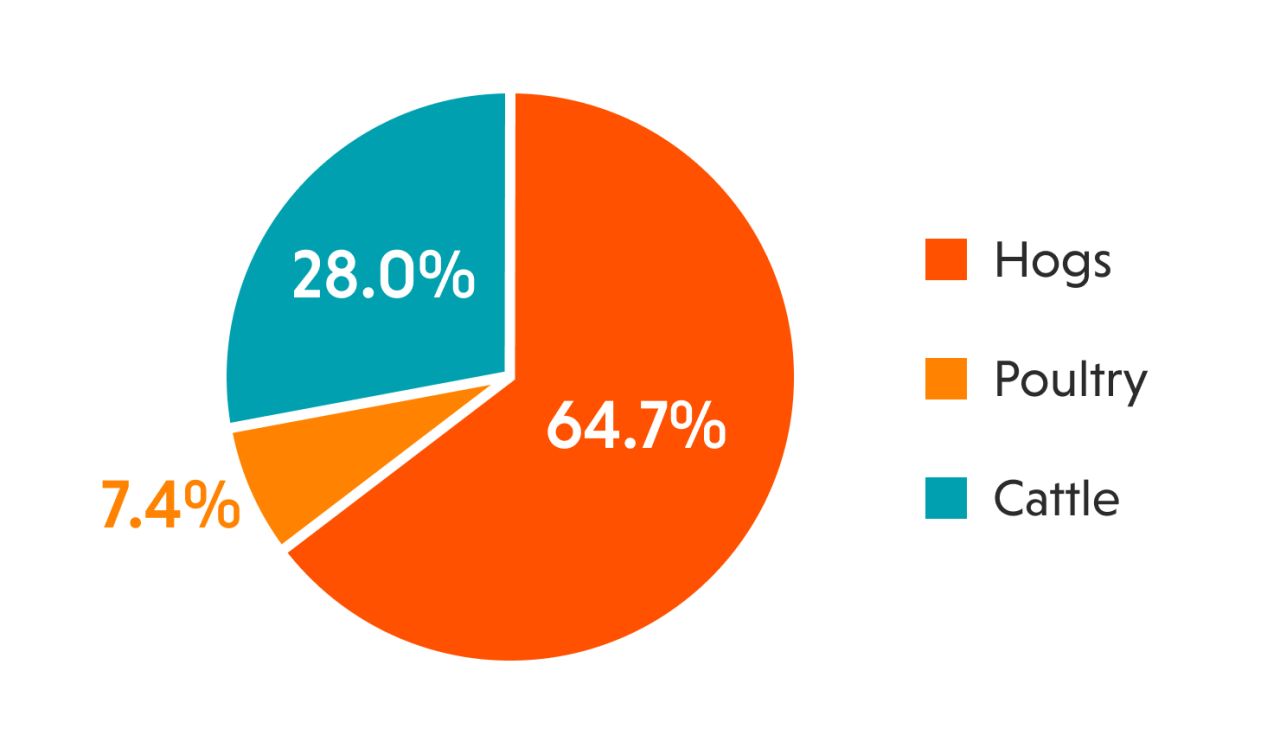
EWG found that Iowa had 15,309 such facilities in 2025. Hogs made up the vast majority of facilities in the state, at 66%.
There were 10,172 facilities housing 33.4 million hogs, 336 poultry facilities housing 178.6 million turkeys and chickens, and 4,801 operations that contained 2.7 million cattle.
Together these facilities produced 107.6 million tons of manure in 2025.
Two-thirds of all factory farms produced swine last year. They also produced the largest share of manure. (See Figure 1.)
Figure 1. Hog facilities generated over 64% of total manure in Iowa.
Source: EWG, with data from Department of Agriculture National Agriculture Imagery Program and Iowa DNR
The five Iowa counties with the most animal feeding operations in descending order were Sioux, Lyon, Plymouth, O’Brien and Washington. These counties contained 3,095 factory farms, or one in five of all facilities in the state.
Water quality problems are especially prevalent in the counties with the most operations. This map shows the locations of all the state’s 15,000-plus factory farms:
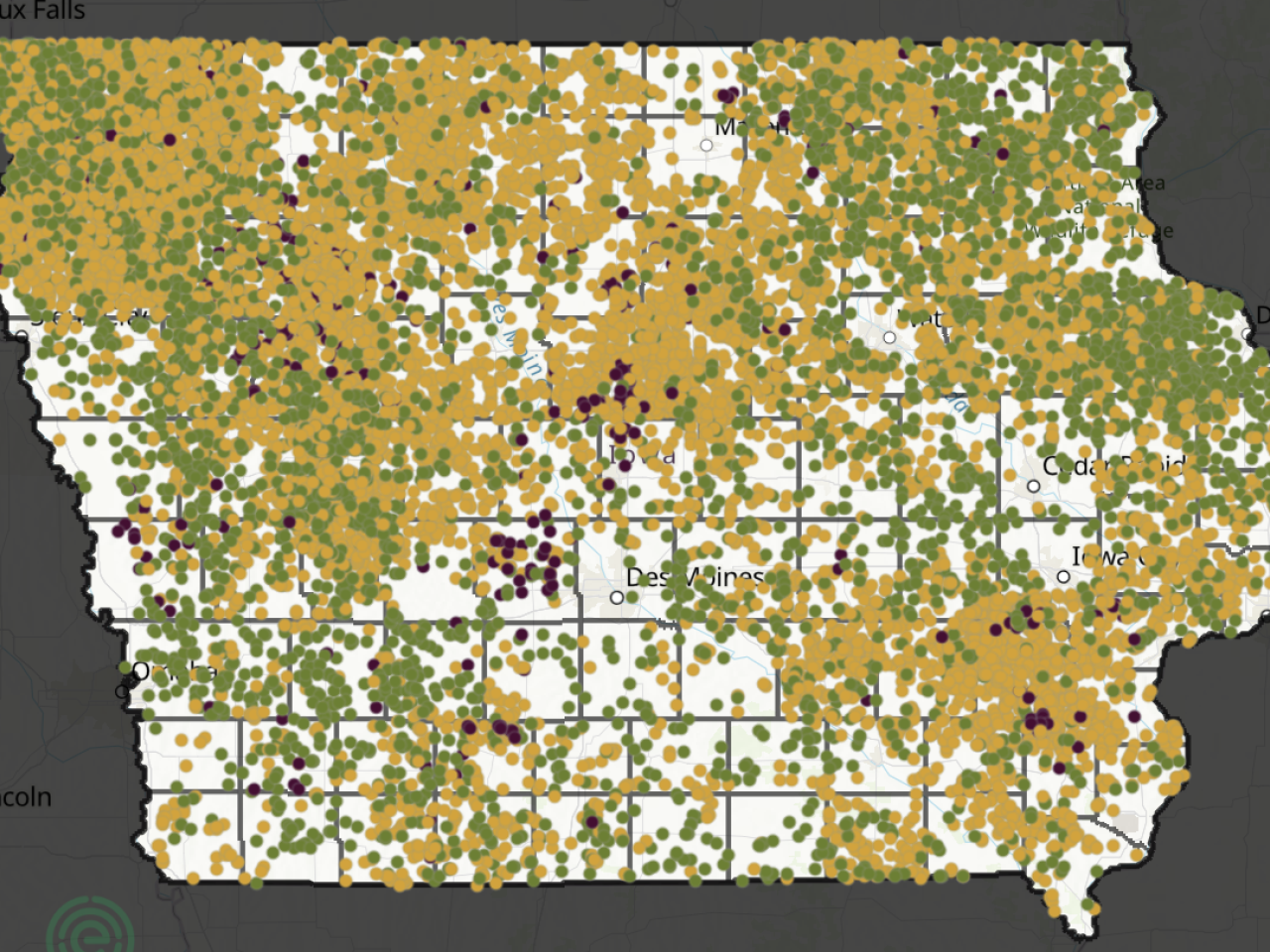
EWG mapped every livestock facility in the state using aerial and satellite imagery, uncovering a much greater industrial footprint than Iowa’s own data suggests.
Large operations have increased since 2019
Iowa has seen a substantial increase in the number of large animal facilities in just the past few years. The largest operations generate the most manure, exacerbating manure storage issues. It becomes increasingly difficult to manage waste without applying excessive amounts to nearby farmland, where it contributes to water pollution and other environmental problems.
For this analysis, EWG used the Environmental Protection Agency’s definition of concentrated animal feeding operations, or CAFOs, to determine farm size. According to the EPA, small facilities have fewer than 300 “animal units,” medium facilities have between 300 and 999, and large facilities have 1,000 or more animal units.
An “animal unit” is defined as an animal that’s equivalent to 1,000 pounds of live weight. For example, a single animal unit would be one 1,000-pound beef cattle, 2.5 hogs or 125 chickens. Large CAFOs house at least 1,000 beef cattle or 2,500 hogs or 125,000 chickens – a lot of animals generating an enormous amount of manure.
The number of large swine operations increased the most between 2019 and 2025, at over 400 facilities.
The largest facilities produced a disproportionate amount of manure. The 4,444 large facilities accounted for 29% of all facilities but generated 60% of all manure.
Medium-size facilities made up 51% of operations but only 35% of the manure. Small farms accounted for only 20% of facilities and 5% of the manure.
This expansion between 2019 and 2025 reflects the continued consolidation of livestock production into larger, more intensive facilities with greater waste management and drinking water challenges.
Sioux, Kossuth and Hamilton counties were the three with the greatest number of large animal feeding operations, where manure application in these counties likely has a big impact on water quality.
Existing regulatory requirements
There were also thousands of factory farms just below the “large” size designation. These operations generate significant amounts of manure but are not required by the EPA to get a National Pollutant Discharge Elimination System, or NPDES, water permit.
To obtain the required permits, large animal feeding operations submit applications that include manure management plans identifying the fields where manure will be applied each year.
Management plans aim to prevent multiple facilities from applying manure to the same fields or applying manure above the agronomic rate.
Animal facilities that have more than 500 animal units but under 1,000 need to submit a manure management plan to the Iowa DNR, but they do not have to get a NPDES permit.
Although manure management plans are an important safeguard, they are often incomplete and inconsistently enforced. In 2025, there were only 745 inspections of manure management plans for Iowa facilities that had over 500 animal units.
Operations with fewer than 1,000 animal units are exempt from many of the permit requirements faced by larger facilities, despite generating enough manure to pose water quality and public health risks similar to the risks of waste generated by large facilities. And those under the 1,000 animal unit threshold with manure management plans are only infrequently inspected.
A total of 3,276 operations had between 950 and 999 animal units – just 50 animal units short of the large CAFO designation. These facilities represented 21% of all facilities in the state and produced a lot of manure, but they are not regulated the same way as operations with 1,000 or more animal units are.
Threat to water and public health
Human waste usually goes through a multistage treatment process before being released back into the environment.
But the more than 100 million tons of manure produced annually by Iowa’s animal operations are typically spread, untreated, on nearby agricultural fields as a fertilizer. It’s the most common disposal option because the waste contains nitrogen and phosphorus, which feed the crops.
But once spread, the nitrogen in manure gets into groundwater, leaches through soil into drainage systems that empty into nearby waterways, and runs off fields to contaminate lakes and streams.
EWG recently released an analysis of nitrate levels in drinking water served by community water systems across the U.S. The report found that, in Iowa, 822 community water systems tested for nitrate between 2021 and 2023.
Of those systems, 146 provided drinking water to almost 1.2 million Iowans and had at least one nitrate test at or above 3 milligrams per liter, or mg/L. During that time, 81 community water systems serving just under 800,000 people tested at or above 5 mg/L, and eight systems serving over 56,000 people tested at or above 10 mg/L.
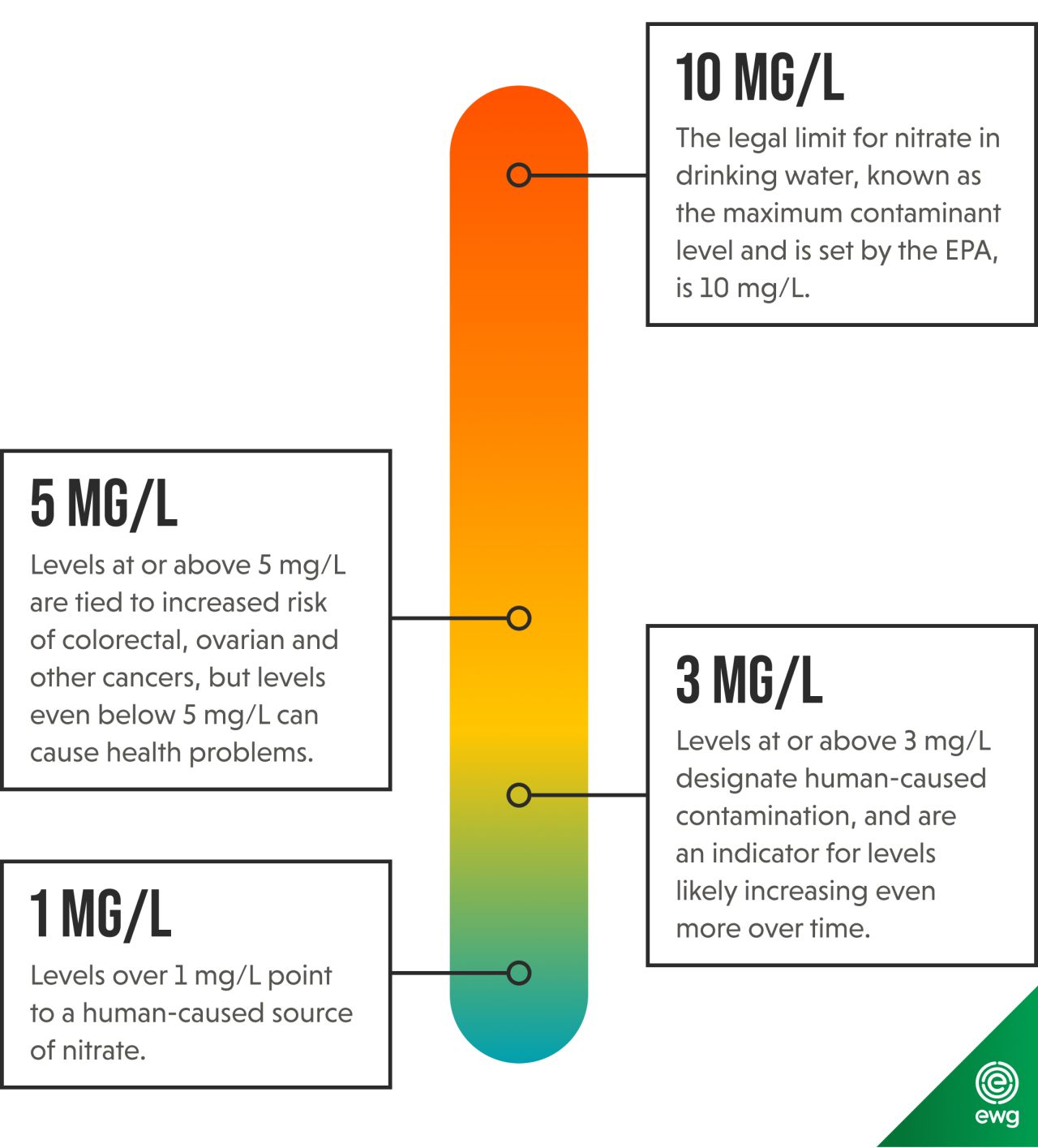
Nitrate contamination in drinking water poses significant risks both to public health and the environment, with the potential harms varying based on the amount of nitrate (see Figure 2).
The EPA’s legal limit for nitrate in drinking water – known as the maximum contaminant level, or MCL – is 10 mg/L. This standard was set based on 1960s science to guard against “blue baby syndrome,” a potentially fatal condition that starves infants of oxygen if they ingest too much nitrate.
More recent research shows strong evidence of an increased risk of colorectal and other cancers, thyroid disease and birth defects at 5 mg/L and other levels far below the woefully outdated federal legal limit for nitrate in drinking water.
Figure 2. Levels of nitrate in drinking water and their associated health risks.
Source: EWG, Drinking water of almost 1 in 5 Americans contains nitrates linked to cancer and birth defects
These findings are especially concerning in Iowa, which has the second-highest incidence of cancer cases in the nation and continues to experience rising cancer rates.
Considerable evidence connects nitrate consumption to increased risk of bladder cancer and colorectal cancer. Emerging research also links kidney, ovarian, thyroid and pediatric cancers with consumption of nitrate in drinking water at levels below the MCL.
The risks of negative birth outcomes for infants also go up when pregnant people drink water contaminated with nitrate, even at levels far below the MCL – preterm birth, low birth weight and birth defects, including neural tube birth defects like spina bifida.
Beyond its impacts on human health, excessive fertilizer and manure application contribute to climate change. Nitrogen from commercial fertilizers and livestock manure is converted in soil into nitrous oxide, a greenhouse gas nearly 300 times more potent than carbon dioxide.
Agriculture is one of the largest sources of nitrous oxide emissions, making improved nutrient management critical for protecting both water quality and the climate.
How consumers and policymakers can help
Consumers
Iowa is the largest producer of pork in the U.S., and swine facilities are the largest contributors of manure in the state. Consumers can choose to eat less meat or eat meat not raised in a factory farm, in turn helping to reduce the environmental and public health damages caused by raising livestock in these facilities. EWG’s Meat and Dairy Label Decoder helps users decipher what individual meat and dairy labels mean about how the livestock generating those food products were raised.
The decoder suggests consumers look for these labels on meat packages at the grocery store to avoid factory-farmed meat:
- Animal Welfare Approved by AGW
- Certified Humane, if the package also includes “grass fed” or “pasture-raised”
- Global Animal Partnership, if the steps are 4, 5 or 5+.
Pictures of EWG’s recommended meat labels are provided below.
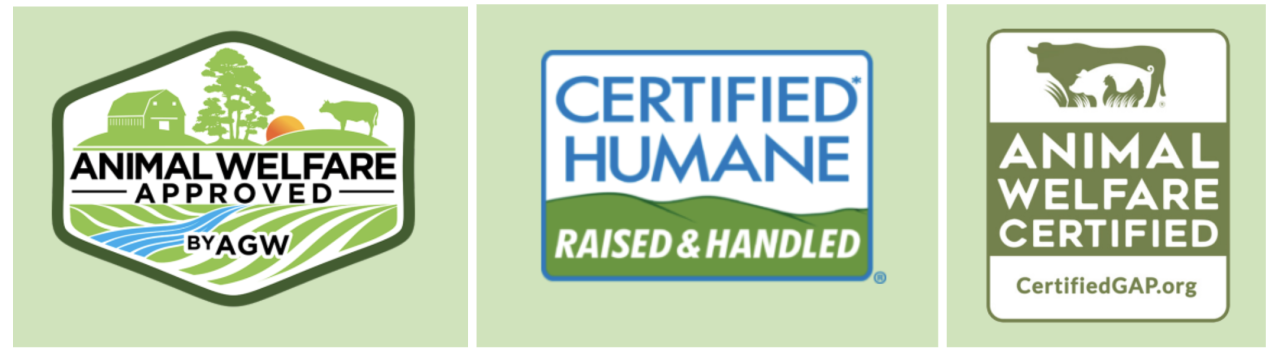
These labels can help consumers choose products from animals raised on pasture, not in factory farms. Pasture-raised animals cause much less of a manure problem.
Policymakers
Changes to federal conservation policy could help reduce one of the largest sources of water contamination in Iowa. Millions of dollars from the Agriculture Department’s Environmental Quality Incentives Program, or EQIP, support infrastructure that compounds the problems of industrial livestock production rather than practices that protect water quality, one of the stated goals of the program.
That is, this money subsidizes infrastructure that supports factory farms.
According to EWG’s Conservation Database, two of the top most-funded EQIP practices in Iowa between 2017 and 2024 were animal manure storage facilities, and roofs and covers for them. Together these two practices received $44.7 million in federal funding during that period, representing 17% of all EQIP dollars awarded to Iowa farmers.
Instead, federal conservation funding should prioritize proven conservation practices that reduce nutrient runoff, improve soil health and protect drinking water. Funding should be prioritized so it goes to practices that improve water quality, like those on EWG’s list of regenerative agriculture practices.
Iowans should also press their state officials to create policy changes that would reduce the amount of manure that gets into water.
The amount of manure that animal feeding operations produce, and where the manure is applied, could be better regulated with a number of policy changes. Many of these policy updates could reduce the risk of cancer Iowans currently face.
One idea that could attract bipartisan support would be to shift the regulation of animal feeding operations to counties. Iowa’s DNR currently manages how livestock facilities operate and expand, as well as the application of manure to farm fields.
Shifting that decisionmaking authority to county governments would give a greater voice to the people who live and work near animal facilities and are most likely to experience the health outcomes tied to the operations.
With this change, county officials would decide whether to approve proposals for building new facilities or expanding existing ones. These officials would also manage the amount of manure that is produced and where it is applied.
Taken together, these achievable federal and state policy changes, along with consumer calls for action and changes to their eating preferences, could make a welcome difference to Iowans’ health.